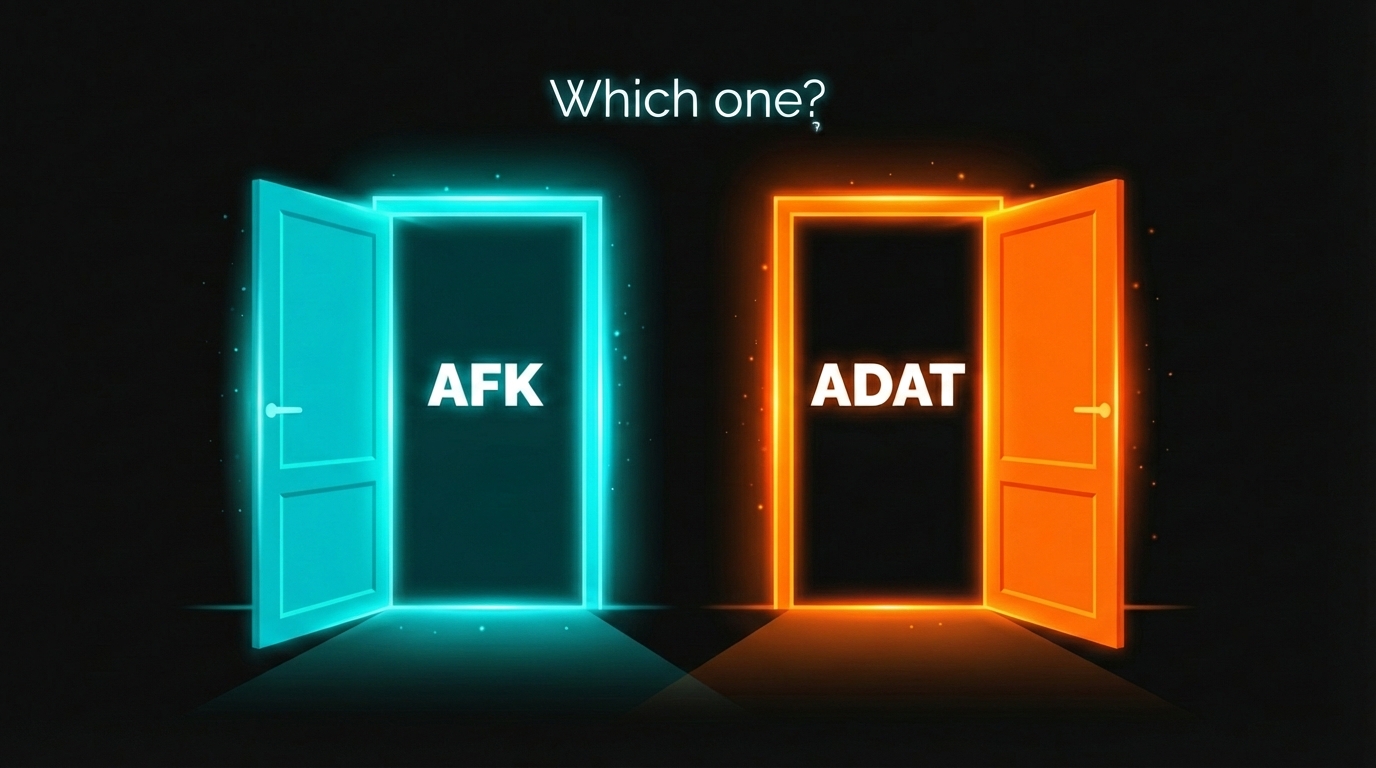
Six months of preparation. Thousands of dollars in courses. Flashcards, question banks, weekends sacrificed. Then someone in a WhatsApp group asks: "Wait, are you studying for the AFK or the ADAT?"
Wrong exam.
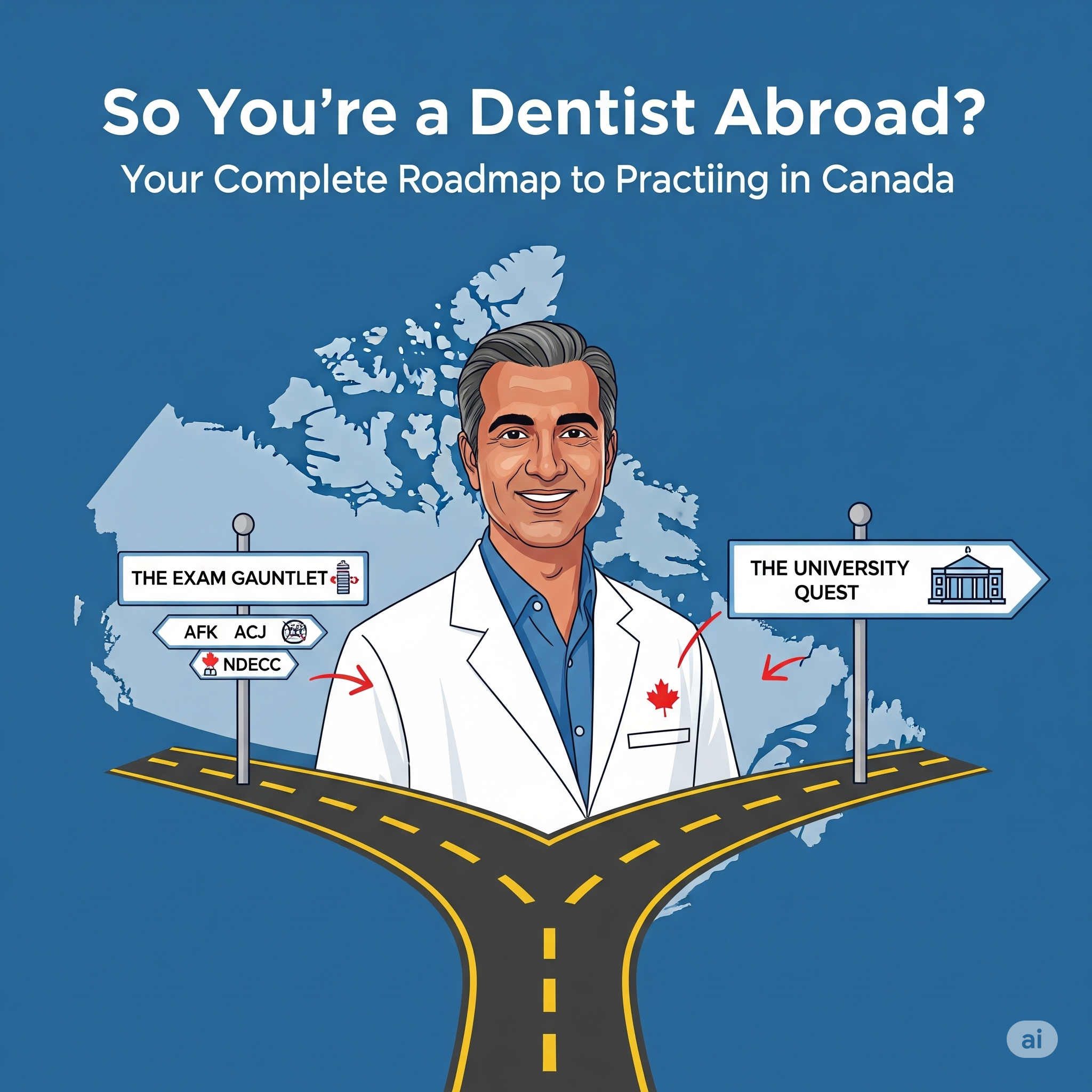
It happens more often than it should. An ITD hears "you need exams to practice in Canada," picks whichever one they hear about first, and starts grinding — without realizing that AFK and ADAT lead to completely different pathways. They're not alternatives. They're not interchangeable. Passing one gives you exactly zero credit toward the other.
The AFK is your entry point if you want to skip dental school entirely and prove competency through exams. The ADAT is your entry point if you want a Canadian dental degree from McGill or U of T.
Choose wrong and you don't just lose time. You lose momentum, money, and the mental energy it takes to start over.
The Short Answer
Two exams. Two completely different doors.
AFK opens the door to the NDEB Equivalency Process — you prove competency through a gauntlet of exams and skip dental school entirely. Faster. Cheaper. Higher risk if you fail.
ADAT opens the door to McGill or University of Toronto — you're applying for a seat in dental school, not avoiding it. Slower. Expensive. But once you're in, the path is clear.
| If your goal is... | You need... |
|---|---|
| Practice in Canada without going back to school | AFK |
| Earn a Canadian dental degree from McGill or U of T | ADAT |
| U.S. specialty residency | ADAT (optional) or neither |
Everything below unpacks what each pathway actually involves — and the real costs that don't show up in the official brochures.
Quick Comparison
| AFK | ADAT | |
|---|---|---|
| Full name | Assessment of Fundamental Knowledge | Advanced Dental Admission Test |
| Administered by | NDEB (Canada) | ADA (United States) |
| Purpose | Entry to NDEB Equivalency Process | Entry to Canadian university programs (+ optional for U.S. specialty residencies) |
| Format | 200 MCQs, two parts, 4 hours total | 200 MCQs, three sections, 4.5 hours |
| Delivery | Paper-based or electronic (Prometric) | Computer-based (Pearson VUE) |
| Testing window | Twice yearly (Feb, Aug) | March 1 – August 31 |
| Scoring | Pass = 75 (rescaled score) | 200-800 scale (500 = mean) |
| Max attempts | 3 total | No published limit |
| What comes after | ACJ → NDECC → Virtual OSCE → License | University admission → 2-3 years school → License |
When You Need the AFK
You already have a dental degree. You've practiced. You don't want to sit in a classroom for another 2-3 years learning what you already know. You just want to prove you're competent and get licensed.
That's the NDEB Equivalency Process. No tuition. No professors. Just a sequence of exams that stand between you and a Canadian dental license. The AFK is the first gate.
Most ITDs choose this route because of what it doesn't require: $100,000+ in tuition and years back in school. But there's a trade-off — you're on your own, and every failed exam costs you more than just the retake fee.
What comes after the AFK
The AFK is just the entrance exam. Pass it, and you unlock the rest of the sequence:
AFK → ACJ → NDECC → Virtual OSCE → Provincial License
| Exam | What it tests | Fee |
|---|---|---|
| AFK | Biomedical + clinical knowledge (written) | ~$1,000 CAD |
| ACJ | Clinical judgement, radiology interpretation | $1,350 CAD |
| NDECC | Hands-on clinical skills + situational judgement (Ottawa) | $6,500 CAD |
| Virtual OSCE | Final certification exam | $2,000 CAD |
Plus the one-time NDEB application fee: $900 CAD
Best-case total (pass everything first try): ~$12,000-15,000 CAD in exam fees, plus prep materials, travel to Ottawa, and living expenses during the process.
But that's best case. More on real costs below.
The AFK pathway timeline
Official estimate: 1.5-2.5 years
Realistic estimate: 2-4 years, depending on exam availability and whether you pass each step on the first attempt.
When You Need the ADAT
Some ITDs don't want to grind through exams alone. They want structure. They want a Canadian degree on their wall, not just a license. They want the credential that comes from graduating from McGill or U of T — institutions that carry weight.
The ADAT is how you get in.
It's not a licensure exam. It's an admissions exam. You're competing for a seat in an advanced standing program where you'll enter as a 2nd or 3rd year student and spend 2-3 years completing a Canadian DDS or DMD.
The cost is brutal — $100,000-200,000+ CAD in tuition. But the timeline is predictable, and you graduate with a degree that opens doors the NDEB certificate doesn't.
McGill DMD Advanced Standing
| Requirement | Details |
|---|---|
| ADAT weight | 70% of preliminary assessment |
| CASPer test | 20% of assessment |
| CV | 10% of assessment |
| Program length | 3 years (enter 2nd year of 4-year program) |
| French proficiency | B2 level required |
| Priority | Quebec residents |
At McGill, your ADAT score is the majority of your initial evaluation. A weak score eliminates you before they look at anything else.
Source: McGill DMD Advanced Standing
University of Toronto IDAPP
| Requirement | Details |
|---|---|
| ADAT | Required (within past 3 years) |
| Eligibility | Canadian citizens or permanent residents only |
| Structure | 6-month IDAPP → enter 3rd year DDS |
| Total duration | ~2.5 years |
| IDAPP fee | ~$78,000 CAD |
| DDS Years 3-4 | ~$45,000 CAD/year |
Important: U of T is not open to international students without Canadian citizenship or PR status.
Source: University of Toronto IDAPP
What about U.S. specialty residencies?
The ADAT was designed for U.S. dental students applying to specialty programs (orthodontics, oral surgery, endodontics, etc.). But here's the reality for the 2025-2026 cycle:
- Programs that require ADAT: None
- Programs that accept but don't require ADAT: Many
- Programs that explicitly won't consider ADAT: Some (including Harvard)
If you're a U.S. dental student, the ADAT is optional. Check each program's specific requirements.
If you're an ITD targeting U.S. practice, you need the INBDE, not the ADAT.
The Real Cost: What the Brochures Don't Tell You
NDEB Equivalency: The retake trap
The official NDEB timeline suggests you can complete the Equivalency Process in 1.5-2.5 years. That assumes you pass every exam on your first attempt.
Here's what actually happens when you fail:
The timing problem: NDEB announces exam results after registration for the next cycle has closed. By the time you know you failed, you can't register for the next sitting.
The seat problem: When registration does open, seats fill immediately. ITDs who already know their status (because they passed or didn't take the previous exam) grab the spots first.
The result: A failed attempt doesn't cost you 6 months. It costs you a full year.
One retake on the AFK or ACJ adds 12 months to your timeline — not because of any rule, but because of how the registration system works.
Real cost scenarios
| Scenario | Timeline | Approximate cost |
|---|---|---|
| Pass everything first try | 1.5-2 years | $15,000-20,000 CAD |
| One retake (AFK or ACJ) | 2.5-3 years | $20,000-30,000 CAD |
| Two or more retakes | 3.5-5 years | $35,000-50,000+ CAD |
These figures include exam fees, prep courses, travel to Ottawa for the NDECC, and basic living expenses during the process. They don't include the income you're not earning while you wait.
A dentist who could be earning $150,000+ CAD annually is instead sitting in limbo, paying rent, watching their savings drain. The opportunity cost dwarfs the exam fees.
University pathway: Expensive but predictable
The ADAT pathway costs more upfront — $100,000-200,000+ CAD for tuition alone. But the timeline is fixed. You're admitted, you complete the program, you graduate. No registration bottlenecks. No year-long waits between attempts.
For some ITDs, the predictability is worth the price.
Content Overlap: If You Switch Pathways
Here's the silver lining if you've been studying for the wrong exam: you haven't wasted everything.
AFK and ADAT test similar material. Anatomy is anatomy. Pharmacology is pharmacology. The pathology questions on both exams pull from the same pool of knowledge. If you've been grinding biomedical sciences for the AFK and realize you want McGill instead, maybe 60-70% of that prep still applies.
The difference is emphasis.
| AFK | ADAT | |
|---|---|---|
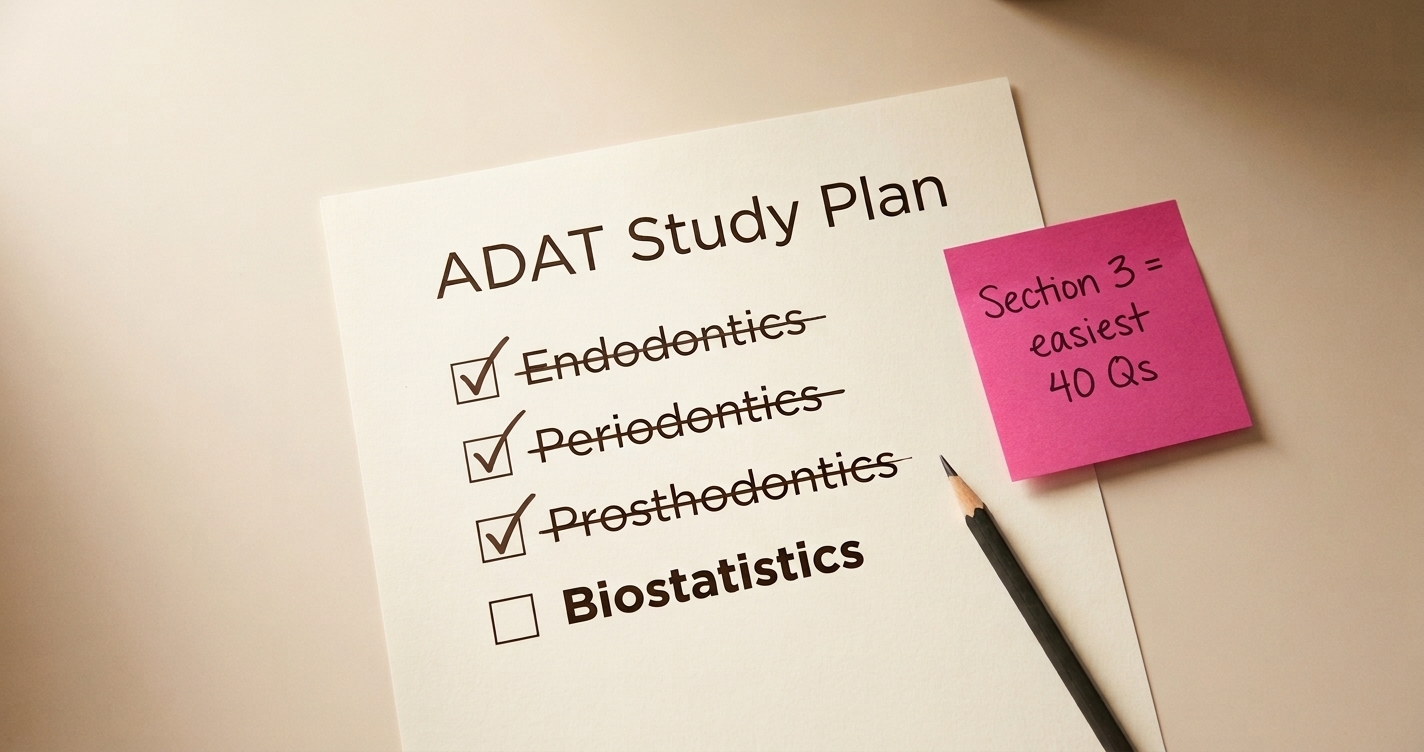
| Research/Biostatistics | ~5% of exam, embedded throughout | 20% of exam, dedicated 40-question section |
| Case-based reasoning | Present | More extensive |
| Specialty depth | General practice breadth | Slightly deeper specialty content |
The ADAT hits research methodology harder — study design, evidence-based dentistry, statistical interpretation. If you've only prepped for the AFK, you'll need to backfill that section. But you're not starting from scratch.
The Decision Framework
Forget the exams for a second. Answer this question first:
Do you want a Canadian dental degree, or do you just want to practice?
If you want the degree — the credential, the alumni network, the letters after your name from a Canadian institution — you need the ADAT. There's no exam-only path to a DDS.
If you just want to practice — see patients, build a career, earn a living — and you're willing to bet on yourself passing a sequence of high-stakes exams, the AFK pathway is faster and cheaper.
The AFK pathway is right if:
You're disciplined enough to study alone. You can handle the financial and emotional risk of the retake trap. You don't have $100,000+ for tuition. You're not eligible for U of T anyway (no PR/citizenship), and you don't speak French (McGill's requirement). You want to be practicing as soon as possible.
The ADAT pathway is right if:
You want the degree, not just the license. You learn better in structured environments. You have Canadian PR or citizenship (required for U of T). You're comfortable in French (required for McGill). You'd rather pay more upfront for a predictable timeline than risk years in the retake trap.
The honest trade-off
AFK: High reward if you pass everything. High punishment if you don't. One failed exam doesn't cost you 6 months — it costs you a year, plus the retake fee, plus the psychological toll of watching your timeline slip.
ADAT: The pain is upfront. Tuition is expensive. But once you're admitted, you know exactly when you'll graduate. No registration lotteries. No year-long waits wondering if you'll get a seat.
Mistakes That Cost ITDs Years
Starting prep before choosing a pathway
The ITD who grinds AFK questions for four months, then realizes they want McGill, then pivots to ADAT prep — they didn't save time by "getting started early." They split their focus and delayed their actual goal.
Decide first. Study second. The order matters.
Treating the NDECC like another written test
The NDECC is not multiple choice. You're in Ottawa, physically performing procedures on dental simulators, being evaluated on technique. ITDs fail this exam not because they lack knowledge, but because their training used different protocols than Canadian standards.
If you're on the AFK pathway, the NDECC is where dreams go to die if you're not prepared. Budget for hands-on prep courses — potentially traveling to Ottawa multiple times before your actual exam date.
Assuming U of T is an option without checking eligibility
University of Toronto's IDAPP requires Canadian citizenship or permanent resident status by the application deadline. Not a work permit. Not a study permit. PR or citizenship.
If you don't have status and aren't close to getting it, U of T isn't on your list. Find out before you register for the ADAT.
Believing the "6-month retake" timeline
Officially, NDEB exams are offered twice a year. Unofficially, if you fail, you're probably waiting 12 months — not 6 — because of how results and registration timelines interact. Plan for this. Don't let it blindside you.
Can You Take Both?
Yes. But ask yourself why.
"Keeping options open" sounds smart until you realize you're now preparing for two different exams with different structures, different testing windows, and different scoring systems. Your study time is split. Your focus is fractured. You're hedging instead of committing.
There are legitimate reasons to take both:
You're applying to McGill (ADAT required) while simultaneously starting the NDEB process (AFK required) because McGill admission is competitive and you want a backup. That's a calculated hedge with a clear rationale.
You started the NDEB pathway, passed the AFK, then decided you actually want the degree. Now you need the ADAT to apply to university. That's a pivot, not a hedge.
But if you're taking both exams because you "haven't decided yet" — that's not a strategy. That's avoidance. Pick a path.
Summary: Your Goal → Your Exam
| Your goal | Your exam | Your pathway |
|---|---|---|
| Practice in Canada, no school | AFK | NDEB Equivalency → ACJ → NDECC → OSCE → License |
| Canadian dental degree (McGill) | ADAT | University admission → 3 years → License |
| Canadian dental degree (U of T) | ADAT | IDAPP → 2.5 years → License (requires PR/citizenship) |
| U.S. specialty residency | ADAT (optional) | Check program requirements |
| Practice in U.S. | Neither | You need INBDE, not AFK or ADAT |
Final Word
The question isn't "AFK or ADAT?" The question is "What do I actually want?"
Do you want a license or a degree? Do you want to bet on yourself passing every exam, or pay for the certainty of a fixed timeline? Do you have the immigration status for U of T? The French for McGill? The savings to survive multiple retakes if the NDEB pathway goes sideways?
Answer those questions. The exam choice follows.
NDEB has the official Equivalency Process requirements. McGill and U of T have their admission criteria. Verify everything directly. Then commit fully to one path.
The ITDs who take the longest to get licensed are the ones who never fully committed to either.
Sources: