You spent three weeks deep in clinical sciences. Restorative protocols, perio classifications, oral surgery complications. Felt productive. Felt like real ADAT prep.
Then you opened a practice test. First question: anatomy. Second: histology. Third: biochemistry. Fourth: more anatomy.
Forty percent of your score. Gone before you even got to the clinical stuff.
Here's what nobody tells you about the ADAT: biomedical sciences isn't "basic science review" you can cram the night before. The ADA designs this exam to assess your potential for success in advanced dental education — and that means testing whether you can apply fundamental knowledge in clinical scenarios, not just recall it. That anatomy question isn't asking you to recite cranial nerve branches — it's describing a patient with a symptom and asking you to figure out which structure got damaged.
This is Part 1 of a three-part ADAT deep dive. If you're still figuring out whether the ADAT is even the right exam for your pathway, start here:
AFK vs ADAT: Which Exam Do You Actually Need?
What You're Actually Up Against
According to the ADA's official ADAT Candidate Guide, the Biomedical Sciences section breaks down like this:
| Sub-Area | Questions | What They're Really Testing |
|---|---|---|
| Anatomic Sciences | ~20 | Can you diagnose from symptoms? |
| Dental Anatomy & Occlusion | ~20 | Do you understand clinical implications? |
| Microbiology & Pathology | ~20 | Can you identify lesions and their origins? |
| Biochemistry & Physiology | ~20 | Do you know why treatments work? |
The pattern is consistent: clinical scenario first, underlying science second. As the ADA states, the exam "evaluates not merely memorization but your ability to apply fundamental knowledge in clinical scenarios." You're being tested on whether you can think like someone ready for advanced training.
Let's break down each area — and more importantly, let's practice the actual question style you'll face.
Anatomic Sciences: When Patients Have Symptoms
A patient walks in with numbness. Another can't move their jaw properly. A third has a swollen floor of mouth.
Your job isn't to remember anatomy flash cards. It's to work backward from the symptom to the structure. That's what this section tests.
The topics that show up here — cranial nerves, foramina, fascial spaces, muscles of mastication — all get framed through clinical problems. A patient after facial trauma who can't smell? That's a cribriform plate question. An IAN block that didn't work? That's a mylohyoid nerve question.
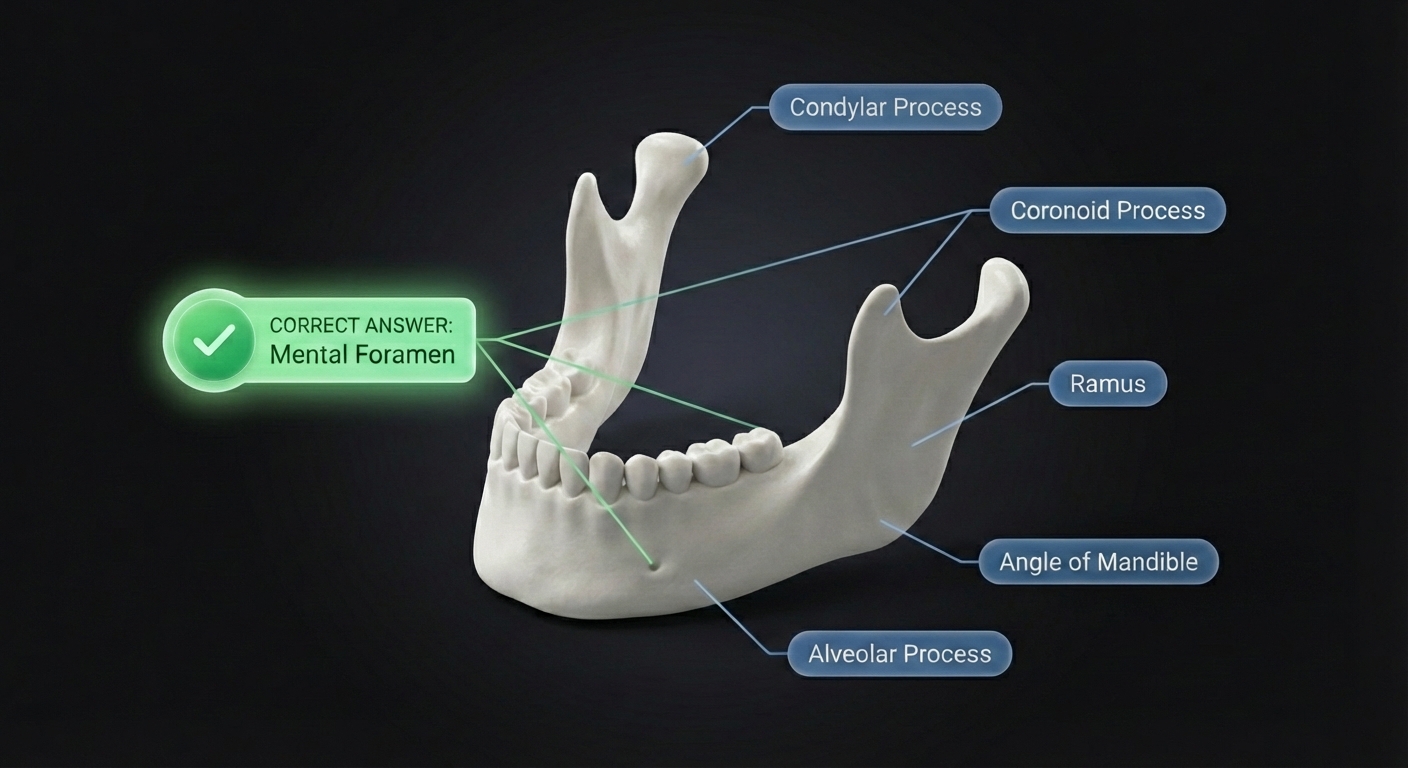
Here's what that looks like in practice:
Notice the pattern? Every question started with a clinical situation. That's not an accident — that's the format.
Dental Anatomy: Beyond Memorizing Tooth Numbers
You know tooth morphology. You learned it years ago. But the ADAT isn't asking you to identify a maxillary first molar from a lineup.
It's asking: during a restoration, which structure matters for fracture resistance? During endo access, where should you look for an extra canal? These are clinical judgment questions dressed in anatomy clothing.
The topics here — root canal configurations, distinguishing features, occlusion, embryology — all connect to decisions you'd make in a real operatory.
Microbiology & Pathology: What Is This Lesion?
A radiograph shows a radiolucency. A biopsy report describes epithelial lining. A patient has a white patch that won't rub off.
This section tests whether you can identify pathology and understand its origins. The epithelial source questions — rests of Malassez vs. reduced enamel epithelium vs. rests of Serres — appear repeatedly because they explain why a lesion forms where it does.
Biochemistry & Physiology: Why Does This Treatment Work?
This section catches people off guard. It's not pure biochemistry (you won't diagram the Krebs cycle). It's pharmacology and physiology through a clinical lens.
A patient on metformin — what's the mechanism? HbA1c reflects three months — why? Bisphosphonates persist in bone for years — what property explains that?
These questions test whether you understand mechanisms well enough to make clinical decisions.
How to Actually Study This
Think in clinical scenarios. When you review anatomy, don't just memorize structures — learn what happens when they're damaged. "CN VII → facial expression" becomes useful when you frame it as "parotid surgery → facial droop risk."
Know epithelial sources cold. For odontogenic cysts, the source explains the location. Rests of Malassez = root-associated. Reduced enamel epithelium = crown-associated. This logic helps you reason through unfamiliar questions.
Understand mechanisms, not just names. Metformin isn't just "a diabetes drug." It's "decreases hepatic gluconeogenesis." That mechanism explains why it doesn't cause hypoglycemia when used alone.
Use the official blueprint. The ADA's ADAT Candidate Guide lists the reference textbooks item writers consult. That's not a guarantee of what's tested, but it indicates the expected depth.
What's Next
You just worked through the biomedical sciences section — 40% of your ADAT score. But clinical sciences and research methodology make up the other 60%.
Part 2: ADAT Clinical Sciences (Coming Soon)
Part 3: ADAT Research & Evidence-Based Dentistry (Coming Soon)
Sources: