
We built QuizOdontist's Custom Mock Builder because we kept seeing the same story: candidates who studied for months, took every mock they could afford, and still failed—not because they weren't smart or didn't work hard, but because they spent hundreds of hours practicing the wrong things.
Generic mocks are a blunt instrument. They test everything equally, which means they waste your time on subjects you've already mastered while barely touching the gaps that will actually sink your score. You can't will your way past that. You can't grind your way past it. The only way through is to take control of what you practice.
That's what the Custom Mock Builder does. You set the subjects. You control the distribution. You choose the difficulty. Every question targets your specific weaknesses instead of some imaginary "average candidate."
But a powerful tool without a strategy is just expensive noise. This guide shows you exactly how to use it: four approaches for different stages of prep, the reasoning behind each one, and the mistakes that waste your time even when you're building your own mocks.
Why One-Size-Fits-All Doesn't Work
Picture three people preparing for the AFK right now. One graduated five years ago and has been practicing general dentistry in India—their clinical intuition is sharp but their Biomedical Sciences is rusty. Another just finished dental school in the Philippines and remembers the basic sciences but hasn't touched a patient in months. A third practiced for a decade in Nigeria, then moved to Canada and spent two years navigating immigration before finally getting a chance to write the exam.
Three people. Completely different gaps. Completely different strengths. Completely different starting points.
Now think about what traditional mock exams offer them: the exact same 150 questions, in the exact same distribution, testing the exact same material. The candidate who needs Pharmacology gets 15 Pharmacology questions—same as the candidate who could teach Pharmacology. The candidate struggling with Oral Pathology gets the same thin coverage as the candidate who aced it.
This is absurd. It's like a gym that only offers one workout routine regardless of whether you're training for a marathon or recovering from knee surgery.
Everyone's prep should be different because everyone's gaps are different. You didn't go to the same dental school as the person sitting next to you in the exam hall. You don't have the same clinical experience. You don't have the same weak spots. Why would identical practice material work for both of you?
Personalized prep isn't a luxury. It's the only approach that makes sense. The Custom Mock Builder exists because you deserve tools that adapt to your situation—not tools that force you to adapt to theirs.
The Three Variables You Control
When you build a custom mock, you're making three decisions. Each one changes what you're practicing and what you're learning.
Question Count
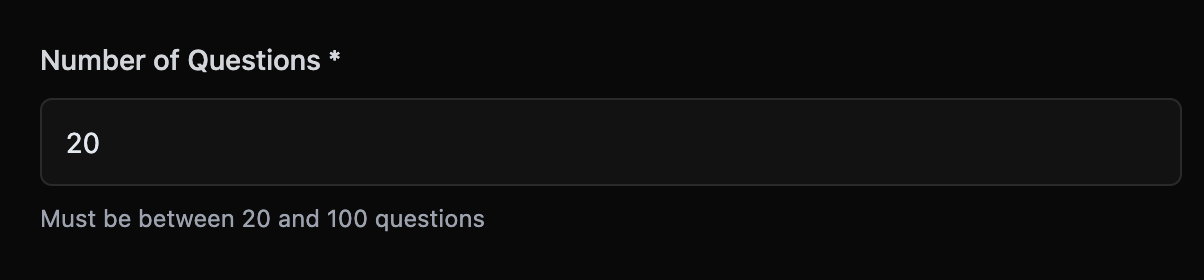
The number of questions determines what kind of practice you're getting:
| Count | What You're Actually Practicing |
|---|---|
| 20-30 | Concept retrieval. Short enough that you'll actually review every wrong answer. Best for learning new material or checking specific knowledge gaps. |
| 50 | Sustained focus. Long enough to identify patterns in your mistakes. This is where most productive learning happens. |
| 100+ | Stamina and time management. Not ideal for learning—you're too fatigued to review effectively. Reserve for the final weeks when you're simulating exam conditions. |
Most candidates default to long mocks because they feel more "serious." This is backwards. Research on learning shows that shorter, more frequent practice sessions with immediate review produce better retention than marathon sessions. A 50-question mock where you review every mistake teaches you more than a 150-question mock where you're too exhausted to analyze what went wrong.
Difficulty Level
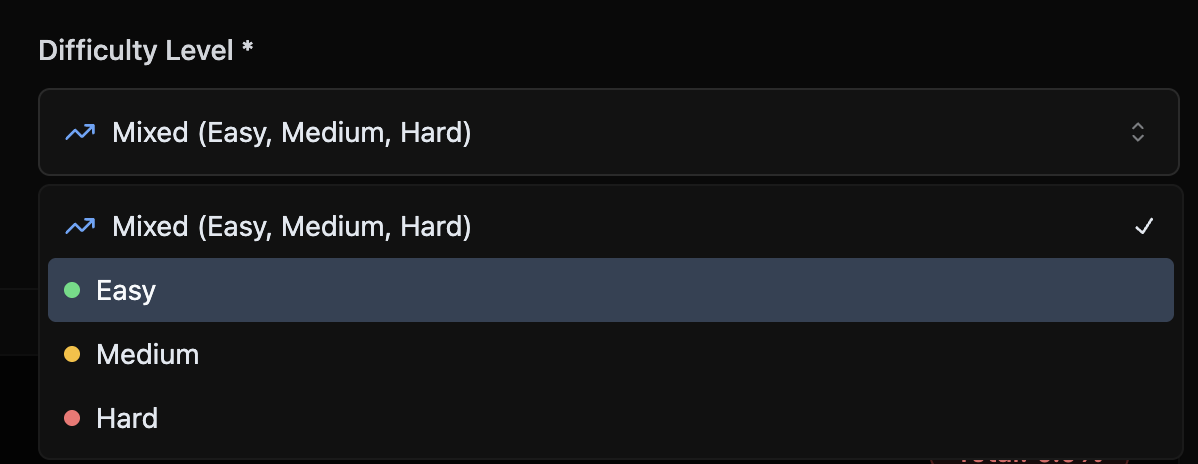
Difficulty isn't just about challenge—it's about what kind of thinking you're practicing:
-
Easy: Tests recognition and recall. Can you identify the correct answer when you see it? Useful for initial exposure to a topic or confirming that foundational knowledge is solid.
-
Medium: Tests application. Can you apply concepts to clinical scenarios? This is where the actual AFK lives—most questions require you to connect multiple pieces of information.
-
Hard: Tests synthesis and edge cases. Can you handle unusual presentations, drug interactions, or competing diagnoses? These questions reveal whether you truly understand the material or just memorized patterns.
-
Mixed: A blend that mirrors the real exam. Use this when you want realistic practice without targeting specific skills.
Here's what matters: difficulty should match your current level in that subject. If you're scoring 50% on Medium Pharmacology questions, Hard Pharmacology questions won't help you—they'll just reinforce confusion. You need to build the foundation first. Learning works best at the edge of your current ability, not far beyond it.
Subject Distribution
This is the variable that matters most. Traditional mocks give you a fixed distribution regardless of your needs. Custom mocks let you put your time where it actually helps.
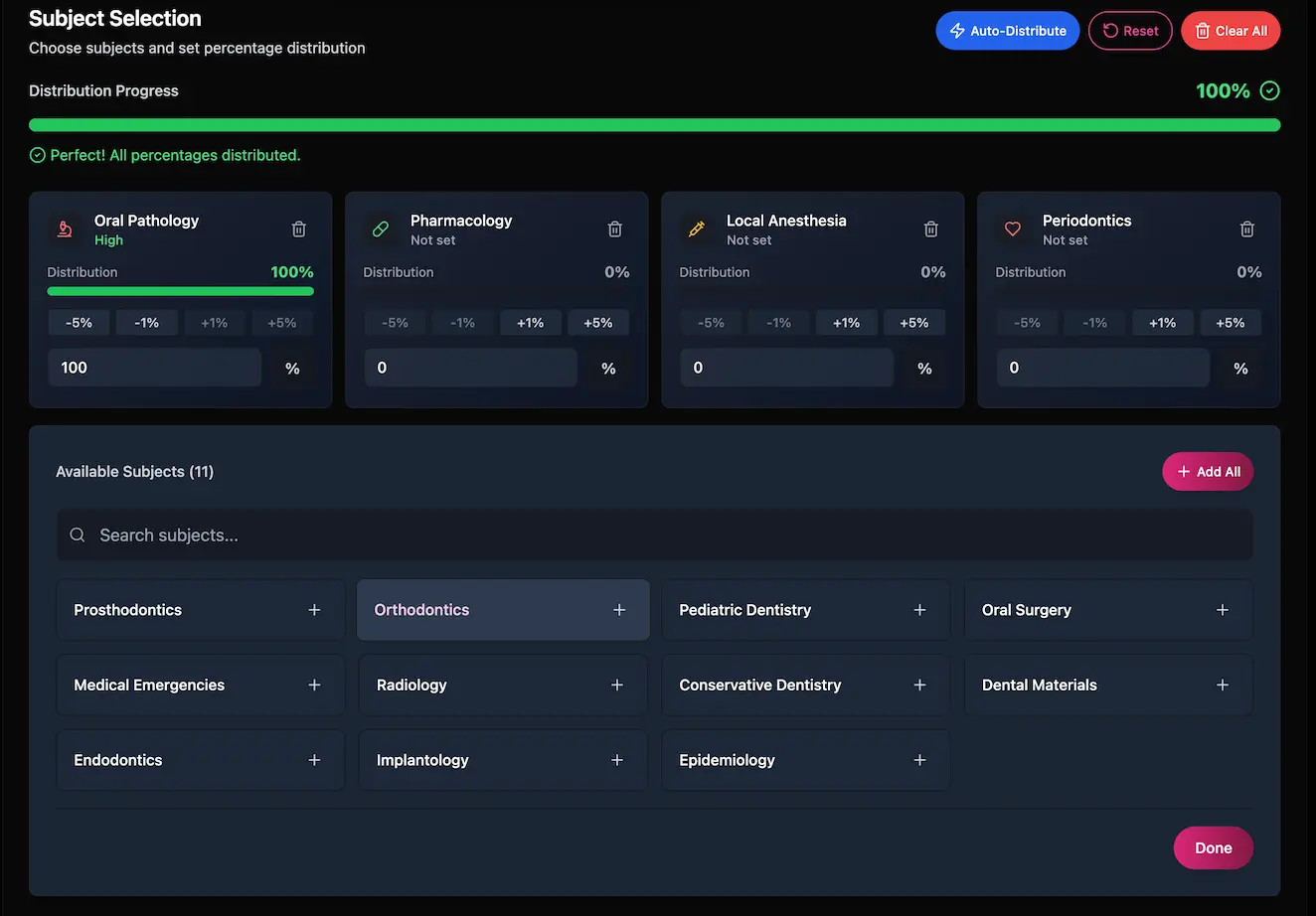
The sliders let you weight subjects however you want:
- 100% single subject when you need focused practice
- Heavy weighting toward weak areas (60-70%) with some maintenance on strong areas
- NDEB blueprint distribution when simulating the real exam
Your distribution should evolve as your preparation progresses. In the early weeks, spread more evenly—you're building a foundation and discovering where the gaps are. In the final weeks, weight aggressively toward weak areas. There's no point spending 30% of your practice time on subjects you've already mastered.
Four Approaches That Work
Different situations call for different mocks. Here are four approaches that address different problems you'll face during preparation—and the reasoning behind why each one works.
Approach 1: The Weakness Attack
When to use: You've identified 2-3 subjects that consistently drag down your scores.
Why it works: Most candidates avoid their weak areas because practicing material you don't understand is uncomfortable. You feel stupid. You get frustrated. So you unconsciously drift toward subjects where you already feel competent.
This is exactly wrong. Learning science calls this the "desirable difficulty" principle—struggle is where learning happens. When you answer a Periodontics question easily, your brain isn't working hard. When you struggle through a Pharmacology question and finally understand why you were wrong, you're forming new neural connections. The discomfort is the learning.
The other reason this works: weak areas have more room for improvement. If you're at 85% in Oral Pathology, grinding more questions might get you to 88%. If you're at 55% in Pharmacology, the same effort could get you to 70%. The math favors attacking weaknesses.
The setup:
- Questions: 50
- Difficulty: Mixed
- Distribution: 40% weakest subject / 35% second-weakest / 25% third-weakest or maintenance subject
How to actually use it:
- Take the mock closed-book
- When you finish, don't just look at your score. Go through every wrong answer and write down why you got it wrong. Was it a knowledge gap? Misread the question? Two answers seemed equally right?
- For knowledge gaps, create flashcards or notes. For reasoning errors, note the pattern so you recognize it next time.
- Take a similar mock in 3-4 days. You should see improvement in the specific concepts you reviewed.
What success looks like: A subject that started at 55% climbs to 65%, then 72%, then 78% over several weeks. This is how systematic improvement actually works—not through hoping generic mocks will cover your weak spots, but through deliberate, targeted practice.
Approach 2: The Blueprint Simulation
When to use: 3-4 weeks before your exam date.
Why it works: There are two things you need to calibrate before the real exam: your overall readiness and your pacing.
The NDEB publishes their exam blueprint. The distribution isn't random—they weight certain subjects more heavily because they're more relevant to clinical practice. When you practice with the same distribution, you're training your brain to allocate attention the way the real exam demands. You learn instinctively that Clinical Dentistry questions will dominate, that Pharmacology will pop up regularly but not overwhelm, that Ethics questions require a different kind of thinking.
More practically, this approach reveals time management issues you won't see in focused mocks. Maybe you're fast at straightforward recall questions but slow when you hit complex clinical scenarios. Maybe you second-guess yourself on ethics questions and burn extra minutes. You need to discover these patterns before exam day, not during it.
The setup:
- Questions: 100-150
- Difficulty: Mixed
- Distribution: Match the NDEB blueprint:
- Biomedical Sciences: 20-25%
- Clinical Dentistry: 35-40%
- Oral Medicine/Pathology/Radiology: 15-20%
- Pharmacology: 10-15%
- Dental Public Health & Ethics: 5-10%
How to actually use it:
- Create exam conditions: timed, no breaks, no phone, no notes
- Note your finish time and calculate your average time per question
- After finishing, don't review immediately—your brain needs recovery time. Review the next day with fresh perspective.
- Pay attention to which subjects slowed you down. Were you actually struggling with the content, or were you overthinking?
What success looks like: You finish with time to spare. You know what 100+ questions in one sitting feels like. You've experienced the mental fatigue and know how to push through it. There are no surprises on exam day because you've already done this.
Approach 3: The Reset
When to use: After a demoralizing session, when you're questioning whether you can do this, or when you've been grinding hard material for days and feel burnt out.
Why it works: AFK preparation typically spans 3-6 months. That's a long time to sustain motivation, especially when you're constantly confronting material you don't know well. Research on sustained performance—from athletes to surgeons to musicians—shows that psychological recovery is not optional. Constant difficulty without relief leads to burnout, and burnout leads to quitting or underperformance.
There's also a cognitive reason this works. When you're stuck in a cycle of failure, your brain starts associating studying with negative feelings. You avoid it. You procrastinate. You half-ass your review sessions. A strategic win interrupts this pattern. It reminds your brain that studying can feel good, that you do know things, that progress is happening even when it doesn't feel like it.
This isn't about ego. It's about sustainability. A candidate who maintains motivation over four months will outperform one who burns hot for six weeks and then flames out.
The setup:
- Questions: 25-30
- Difficulty: Easy
- Distribution: 70% strongest subject / 30% second-strongest
How to actually use it:
- Take it when you're feeling low. Don't try to power through—that's how you develop study aversion.
- Aim for 85%+ score. If you're not hitting that on easy questions in your best subjects, there's a different problem.
- Let yourself feel good about the score. This isn't cheating. This is maintenance.
- Return to harder work the next day, recharged.
What success looks like: You finish preparation without burning out. You maintain a sustainable study schedule across months instead of sprinting and crashing. When the hard weeks come, you have psychological reserves to draw on.
The constraint: Once per week maximum. If you're taking these more often, you're avoiding real practice. This is recovery medicine, not a regular diet.
Approach 4: The Reality Check
When to use: Final 1-2 weeks before your exam, on subjects you believe you've mastered.
Why it works: One of the most dangerous things in exam prep is false confidence. You've been scoring well on mixed-difficulty mocks, you feel good about Oral Pathology, so you stop practicing it. Then you hit the real exam and discover that you only knew the easy and medium questions. The hard questions—the ones that actually differentiate passing from failing—expose gaps you didn't know existed.
This approach forces honesty. Easy questions test whether you recognize correct answers. Hard questions test whether you actually understand the material deeply enough to apply it in unfamiliar situations.
There's another reason to do this: calibration. Overconfident candidates don't study enough. Underconfident candidates waste time on material they've already mastered. Neither is optimal. A reality check gives you accurate information about where you actually stand, so you can allocate your remaining study time intelligently.
The setup:
- Questions: 40-50
- Difficulty: Hard
- Distribution: 100% single subject you believe you've mastered
How to actually use it:
- Before starting, write down the score you expect to get. Be honest.
- Take the mock.
- Compare your prediction to reality.
- If you scored 15+ points below your prediction, you haven't mastered this subject—you've mastered the easy questions. Adjust your study plan accordingly.
What success looks like: Either you confirm that yes, you really do know this material at a deep level, or you discover that you have more work to do while there's still time to do it. Both outcomes are valuable. What you don't want is to discover false confidence during the actual exam.
How This Looks Over a 6-Week Prep Period
The four approaches aren't random options—they serve different purposes at different stages. Here's how they typically sequence:
| Week | Primary Approach | Why |
|---|---|---|
| 1-2 | Weakness Attack (3-4x/week) | Early weeks are for discovery. You're finding out where the gaps are and starting to fill them. Every mock teaches you something new about what you don't know. |
| 3 | Weakness Attack + Reset (4x/week) | By week 3, you've been hitting hard material for a while. Mix in one reset session to maintain motivation while continuing to address weaknesses. |
| 4 | Blueprint Simulation (2x/week) | Time to start practicing the real exam format. You're not learning new material as much as integrating what you've learned. |
| 5 | Blueprint Simulation + Reality Check (3x/week) | Validate that subjects you think you've mastered actually hold up under pressure. Identify any remaining false confidence. |
| 6 | Blueprint Simulation only (2-3x) | Final week is for calibration, not learning. You're confirming readiness and building confidence. Don't introduce new difficulty here. |
The progression follows a principle: learning happens early, integration happens in the middle, and validation happens at the end. Trying to learn new material in the final week creates anxiety without much benefit. Trying to simulate the real exam in week 1 doesn't help because you haven't built the foundation yet.
Mistakes That Waste Your Time
Using the same distribution for weeks
Your weak areas change as you study. The subject that was dragging you down in week 1 might be average by week 3. If you don't reassess regularly—every 1-2 weeks—you end up practicing material you no longer need to practice. Check your scores by subject and adjust accordingly.
Only taking long mocks
There's a misconception that "serious" practice means marathon sessions. Actually, shorter mocks (30-50 questions) are usually more valuable for learning because you have the mental energy to review properly afterward. Long mocks are for stamina training and simulation, not for learning new material. If you're always exhausted after a mock, you're not getting the review benefit.
Skipping the review
Taking a mock and looking at your score teaches you almost nothing. Taking a mock and reviewing every wrong answer is where the actual learning happens. If you don't have time to review, take a shorter mock. A 30-question mock with thorough review beats a 100-question mock where you just glance at the score.
Not tracking time
The AFK is time-pressured. If you consistently finish mocks with 30 minutes to spare, you're probably going too fast and making careless errors. If you consistently run out of time, you're going too slow and leaving questions unanswered. Track your pace on blueprint simulations so you know how to adjust before the real exam.
Starting Point
If you're early in your prep (more than 4 weeks out), start with the Weakness Attack approach. Identify your 2-3 weakest subjects and build a mock weighted toward them. Take it, review thoroughly, and repeat in a few days.
If you're closer to exam day (3-4 weeks out), start with Blueprint Simulations. You need to know how you perform under realistic conditions, and you need to discover any time management issues before they cost you.
The key insight: every mock should serve a specific purpose. "I'll just take a practice test" isn't a strategy. "I'm going to hit my weak areas with a 50-question focused mock and review every wrong answer" is a strategy. The difference determines whether your practice time actually moves you toward passing.
Related Reading