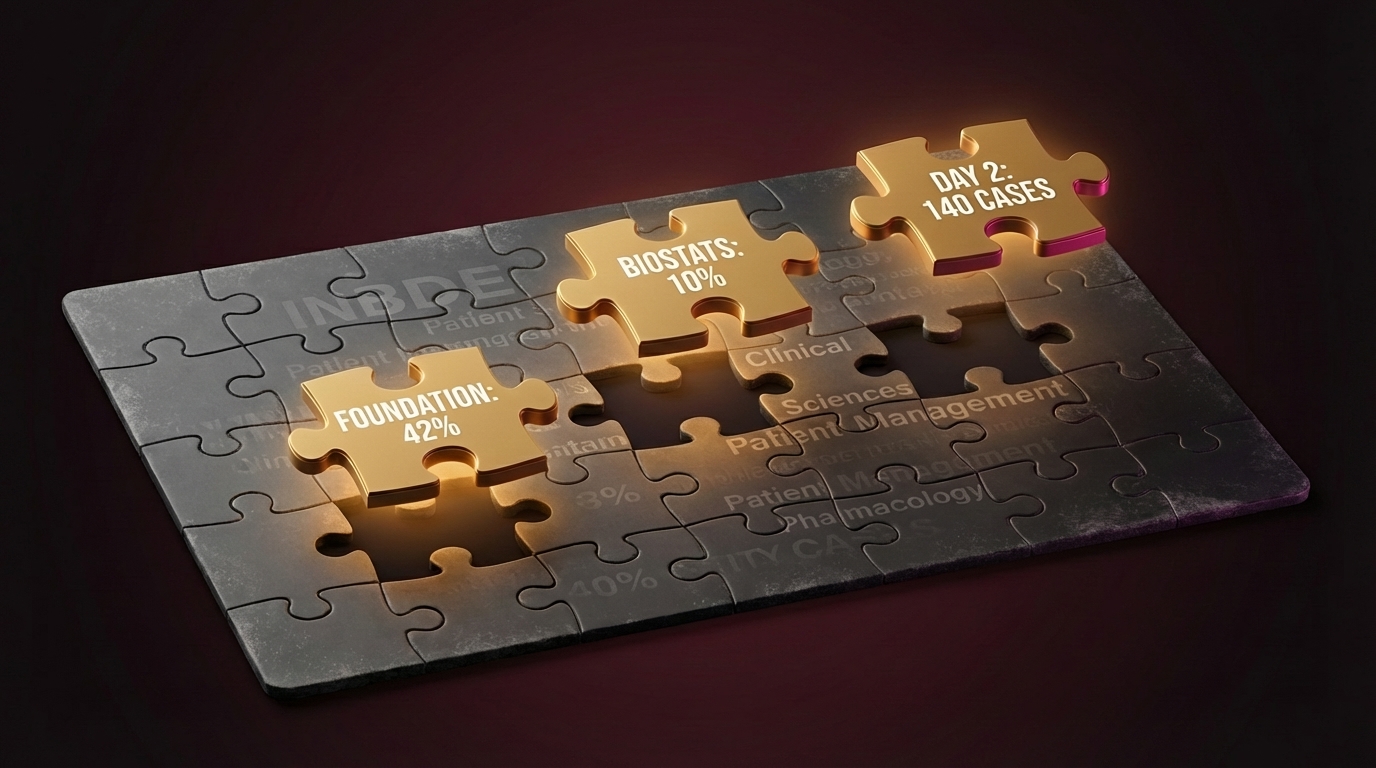

360 questions on Day 1. 140 on Day 2. Over 12 hours of testing.
Most candidates prepare for the content. Almost nobody prepares for what it feels like to come back on Day 2.
It's Day 1 of your INBDE. You arrived at the Prometric center at 7:30 AM, nerves buzzing, coffee in hand. Now it's 5 PM. You've spent 8 hours answering 360 questions. Your eyes are strained. Your brain feels wrung out. You walk out into the fading daylight, and one thought keeps echoing:
I have to do this again tomorrow.
Every study guide, every prep course, every well-meaning classmate focuses on what to study. Biomedical sciences. Clinical reasoning. Case-based questions. And yes, all of that matters. But if you're not prepared for the format—for what it actually feels like to come back on Day 2—all that content knowledge might not be enough.
Different Roads, Same Mountain
The people staring down the INBDE come from very different places—but they're all climbing the same mountain.
Maybe you're a D4 student at a CODA-accredited program, juggling clinic rotations, residency applications, and the growing anxiety of boards. You've heard the horror stories in the hallways. Someone always knows someone who "felt great" walking out and still didn't pass.
Maybe you're an internationally trained dentist—a skilled clinician with years of real-world experience—who left behind an established career, a familiar country, and everything you knew for the chance to practice in the United States. The INBDE is your gateway to advanced standing programs. But passing it is just step one — you'll still need to complete a 2-3 year program at a U.S. dental school before you can practice. There's no Plan B. The stakes couldn't be higher.
Or maybe you're a recent graduate who took some time off after dental school and now you're trying to dust off knowledge that felt rock-solid during finals but has grown frustratingly fuzzy.
Different starting points. Different pressures. But the same destination: passing a two-day exam that will determine whether you can practice dentistry in America.
According to the Joint Commission on National Dental Examinations (JCNDE), the INBDE is accepted by all U.S. states and territories. It's administered at Prometric Test Centers across the US, its territories, and Canada (excluding Quebec).
Important for internationally trained dentists: The INBDE is for U.S. licensure only. If you want to practice in Canada, you need the NDEB Equivalency Process — a completely separate pathway involving the AFK, ACJ, NDECC, and Virtual OSCE. The INBDE does not count toward Canadian licensure.
Day 2 Hits Different
Most exams—even brutal ones—have a clear endpoint. You suffer through it, walk out, and it's over. You can collapse on your couch, eat garbage food, and process what just happened.
The INBDE doesn't give you that release. Not after Day 1.
Instead, you leave the testing center with your brain still buzzing from hundreds of questions. You're second-guessing every answer you flagged. You're wondering if you should have chosen B instead of C on that tricky pharmacology question. And somehow, you have to shut all of that down, get a good night's sleep, and show up tomorrow ready to perform at your best.
That overnight reset—the ability to recover, compartmentalize, and come back sharp—is the hidden test within the test.
The INBDE doesn't just test what you know. It tests whether you can still access what you know after 8 hours of cognitive load.
And Day 2 isn't the "easier" day just because it's shorter. All 140 questions are case-based, requiring sustained reading and clinical reasoning. You can't coast on rapid-fire recall. If you're mentally depleted from Day 1, those cases will feel twice as hard.
What You're Actually Facing
The structure, per the JCNDE:
Day 1: The 8-Hour Grind
| Section | Questions | Time | What You're Facing |
|---|---|---|---|
| Section 1 | 100 | 105 min | Standalone questions |
| Section 2 | 100 | 105 min | Standalone questions |
| Section 3 | 100 | 105 min | Standalone questions |
| Section 4 | 60 | 105 min | Case-based questions |
| Total | 360 | ~8h 15m |
Day 1 is a marathon within a marathon. Three hundred standalone questions followed by 60 case-based questions. By the time you reach Section 4, you've already been testing for over 5 hours. Your brain is tired. The cases require more reading, more synthesis, more effort—right when you have the least energy to give.
You get 15-minute breaks after each section, plus a 30-minute lunch. These aren't luxuries. They're survival tools. (More on this later.)
Day 2: The Case-Based Gauntlet
| Section | Questions | Time | What You're Facing |
|---|---|---|---|
| Section 1 | 70 | 105 min | All case-based |
| Section 2 | 70 | 105 min | All case-based |
| Total | 140 | ~4h 15m |
Shorter? Yes. Easier? Not necessarily.
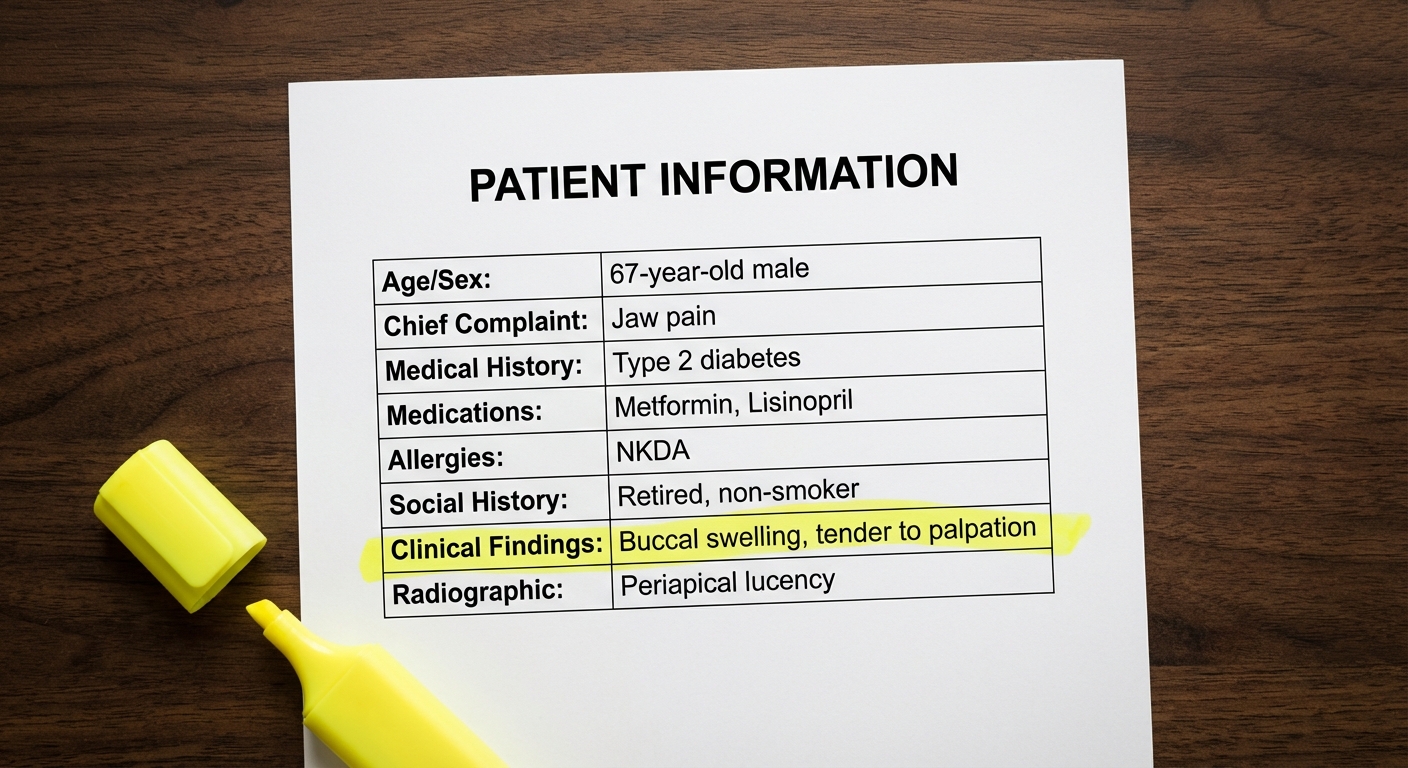
Every single question on Day 2 is case-based. Patient scenarios. Clinical findings. Radiographs. Treatment planning. You need to read carefully, synthesize information, and apply clinical reasoning—tasks that require a fresh mind.
If you show up to Day 2 exhausted, anxious, or sleep-deprived from obsessing over Day 1... those 140 questions will feel like 300.
The Rules That Bind You
Per the JCNDE:
- Both days must be at the same Prometric test center
- Day 2 must occur within 7 days of Day 1
- The days do not need to be consecutive—you choose your schedule
Fail to meet these requirements? You retest at your own expense. No exceptions, no appeals.
Back-to-Back or Build in Recovery?
This is the question every INBDE candidate wrestles with. Should you schedule Day 1 and Day 2 consecutively, or take a day or two to recover?
There's no universally correct answer. But there is a wrong way to decide: guessing based on what sounds easier.
The Case for Consecutive Days
Some candidates swear by the "rip off the Band-Aid" approach:
- Maintain momentum. You're already in exam mode. Stay there.
- No time to spiral. If Day 1 felt rough, you don't have 48 hours to convince yourself you failed.
- It's just over faster. There's psychological relief in knowing that by tomorrow evening, the INBDE will be behind you.
This works well if you're someone who handles sustained pressure well and tends to overthink when given downtime.
The Case for Taking a Gap
Other candidates need the reset:
- Physical recovery. Eight hours of testing is exhausting. Your body needs rest.
- Mental processing. Sleep is when your brain consolidates memories. A recovery day lets Day 1 knowledge settle.
- Fresh start. Walking into Day 2 rested feels different than walking in depleted.
This works well if you're prone to fatigue, need solid sleep to function, or find that rest improves your performance.
What You Should NOT Do
Use the gap day to cram.
If you don't know something by Day 1, one panicked evening of flashcards won't save you. What will hurt you is showing up to Day 2 exhausted because you stayed up reviewing.
The enemy of Day 2 success isn't lack of knowledge. It's fatigue.
Why Your Brain Betrays You (And What Science Says About It)
Most prep courses skip this: your performance naturally declines as the day goes on—regardless of how well you know the material.
Research published in PNAS found that for every hour later in the day, standardized test performance drops by about 0.9% of a standard deviation. That sounds small, but across 8+ hours, it compounds.
By the time you hit Section 4 of Day 1, you're not performing at your peak. Not because you didn't study enough—because you're human.
The same research found something else: a 20-30 minute break can improve performance by 1.7% of a standard deviation.
Breaks aren't rest. They're performance tools.
Other research from PLOS ONE found that while subjective fatigue (how tired you feel) increases throughout long exams, objective performance can remain stable—if you've trained for endurance.
Athletes don't show up to marathons without running long distances first. Surgeons don't perform 8-hour procedures without building stamina. Why would you walk into a 12-hour exam without training your brain to perform under sustained pressure?
Training for the Marathon (Not Just the Material)
Most INBDE prep focuses on content. Subject quizzes. Practice questions. Reviewing weak areas.
All of that matters. But it's not enough.
If your longest practice session is 50 questions, you have no idea how you'll perform on question 300. If you've never simulated a full exam day, you don't know when your focus will start slipping.
Build Endurance Into Your Prep
In the final weeks before your exam:
Simulate real conditions. Take full-length timed practice sessions. Not 50 questions here and there—360 questions in one sitting, with timed breaks matching the real exam structure.
Practice the break strategy. During your simulations, take 15 minutes between sections and a 30-minute lunch. See how it affects your energy. Figure out what snacks work, whether you need to walk around, whether caffeine helps or hurts.
Build progressively. Start with 100-question sessions. Work up to 200. Then 300+. Train your focus like you'd train a muscle.
QuizOdontist Tip: Our Custom Mock Builder lets you create timed practice exams that mirror the real INBDE structure. Build Day 1-style sessions with standalone-heavy mixes, or Day 2-style sessions with all case-based questions. The goal isn't just to practice content—it's to practice performing under INBDE conditions.
Protect Your Sleep Like Your Career Depends On It
Because it does.
Research from the Sleep Foundation shows that students who sleep 7-8 hours before exams consistently outperform those who sacrifice sleep to cram.
Sleep isn't wasted time. It's when your brain consolidates everything you studied. Cutting it short is self-sabotage.
The week before your exam: Get on a consistent sleep schedule. No more staying up late and sleeping in. Your body needs to be in rhythm.
The night before Day 1: Wind down early. Light review only—nothing new. Aim for 7-8 hours.
Day 1: A Battle Plan for the 8-Hour Grind
You've prepared. Now it's time to execute.
The Morning Of
Don't rush. Wake up with plenty of time. Rushing creates anxiety, and anxiety burns mental energy before you even start.
Eat strategically. Complex carbs plus protein: oatmeal with nuts, eggs with whole grain toast, yogurt with fruit. Skip the sugary cereals and pastries—they spike your blood sugar and crash it mid-morning.
Arrive 30 minutes early. Per JCNDE requirements, you'll need two forms of ID, and the name must match your application exactly. Don't add "will they let me in?" stress to exam day.
During the Exam
Use every break. Every single one. Don't skip breaks thinking you'll "get ahead." You won't. What you will do is burn out faster.
During breaks:
- Step away from the screen completely
- Hydrate (but not so much you're uncomfortable)
- Eat a small snack—something with protein and complex carbs
- Stretch, walk, move your body
- Use the bathroom even if you don't desperately need to
Pace yourself. You have 105 minutes for 100 questions—over a minute each. That's plenty of time. Don't rush through easy questions trying to bank time for hard ones. Rushing causes careless mistakes.
Reset after each section. Struggled with a question? Frustrated by a confusing case? Leave it behind when you submit the section. What's done is done. Each section is a fresh start.
The Lunch Break
Thirty minutes. Use them wisely.
Eat real food. Not just a granola bar. Your brain has been working hard and needs fuel for the afternoon push. Pack something substantial.
Don't review. Seriously. You will not learn anything meaningful in 30 minutes, and you'll just stress yourself out trying.
Move. A short walk gets blood flowing and clears mental fog. Don't just sit in the waiting area scrolling your phone.
The Afternoon Push (Sections 3 and 4)
This is where the marathon gets hard. Expect it.
Section 3 is your third round of 100 standalone questions. By now, the fatigue is real. Your reading speed may slow. Your confidence may waver.
Section 4 is case-based—longer stems, more reading, more synthesis. This is where unprepared candidates fall apart.
Strategies for the home stretch:
- If you feel your focus slipping, pause. Close your eyes. Take three deep breaths. Reset.
- Don't panic if questions feel harder. Your perception of difficulty increases with fatigue even when actual difficulty doesn't.
- Remember: 60 more questions and Day 1 is done.
The Night Between Days
You've survived Day 1. Now comes the part no one prepares you for: the overnight reset.
What you do in the next 24 hours will directly impact your Day 2 performance.
What NOT to Do
Don't obsess over Day 1. You will remember the hard questions. You will forget the 200+ questions you answered confidently. This is how human memory works. The questions haunting you are not representative of your actual performance.
Don't cram. If you didn't know it for Day 1, a panicked evening of studying won't help. What it will do is exhaust you for Day 2.
Don't stay up late "just reviewing a few things." Sleep is more valuable than any last-minute studying. This is non-negotiable.
Don't doom-scroll Reddit looking for other people's experiences. You'll find horror stories that spike your anxiety and success stories that make you feel worse by comparison. Neither helps.
What TO Do
Eat a real dinner. Something nutritious and satisfying. You burned a lot of mental energy today.
Move your body. A walk, some light stretching. Nothing strenuous—just enough to release tension.
If you absolutely must review, keep it to 30 minutes. High-yield topics only. Then stop. Close the books. Put away the flashcards.
Go to bed early. Earlier than you think you need to. Your brain will process Day 1 while you sleep, and you'll wake up sharper.
Stick to your morning routine for Day 2. Same breakfast. Same arrival time. Familiarity reduces anxiety.
If You Have a Gap Day
Same principles apply, stretched over more time.
Don't use the gap day to cram. Use it to recover. Watch something relaxing. Go for a walk. Let your brain rest.
One light review session is fine if it calms your nerves. But the goal of the gap day is rest, not last-minute studying.
Day 2: The 140-Question Gauntlet
Day 2 is shorter. It is not easier.
The Case-Based Challenge
Every question on Day 2 is case-based. Patient scenarios. Clinical findings. Diagnostic images. Treatment planning decisions.
This requires different mental energy than standalone questions:
- More reading. Each case presents information you need to absorb and hold in working memory.
- More synthesis. You're not just recalling facts—you're applying clinical reasoning.
- More sustained attention. You can't rapid-fire through cases the way you might with standalone questions.
If you show up depleted, distracted, or anxious, these cases will feel twice as hard as they actually are.
Pacing Day 2
You have 105 minutes for 70 questions per section—1.5 minutes per question. More time than Day 1.
Read cases carefully. Missing a detail in the patient history can lead you straight to the wrong answer.
Don't rush. The time pressure is less intense. Use the extra margin to be thorough.
Manage the "Day 1 hangover." You may feel mentally sluggish, especially in the first section. This is normal. Push through the initial fog—it usually lifts.
The Final 70 Questions
When you start Section 2 of Day 2, you're in the final stretch. Seventy questions stand between you and the end of the INBDE.
Stay focused. Don't let relief make you careless. These questions count just as much as the first 70 of Day 1.
Use all your time. If you finish early, review flagged questions. Don't rush out just because you can see the finish line.
And then... you're done.
Why People Fail
Most candidates who fail the INBDE knew the material. They studied the subjects. They drilled questions. They could have passed a 3-hour version of this exam.
But they didn't prepare for 12 hours across two days. They didn't train endurance. They didn't plan their Day 1 recovery before Day 1 even happened.
Most failures aren't from lack of knowledge. They're from running out of gas before the finish.
QuizOdontist was built with this philosophy. Our Custom Mock Builder lets you create practice exams that match the real INBDE structure—so you can train your brain for the marathon, not just the material. Our Analytics Dashboard shows you when in a session your performance starts to dip, so you can identify fatigue issues before exam day.
500 questions. Two days. Thousands of study hours behind you.
Don't let the format beat you after all that.