You already know how to build a custom mock. You pick subjects, set percentages, choose a difficulty, click create. The mechanics take two minutes.
But what should you actually put in the mock? A candidate who's bombing Pharmacology needs a completely different mock from one who's scoring 80% everywhere but crumbles under time pressure. And both of them need something different from the candidate who just needs to prove to themselves they're not failing.
We built the Custom Mock Builder for exactly this. Here are four mock archetypes — one for each of those situations — and when to reach for each one.
The Four Archetypes
Weakness Attack
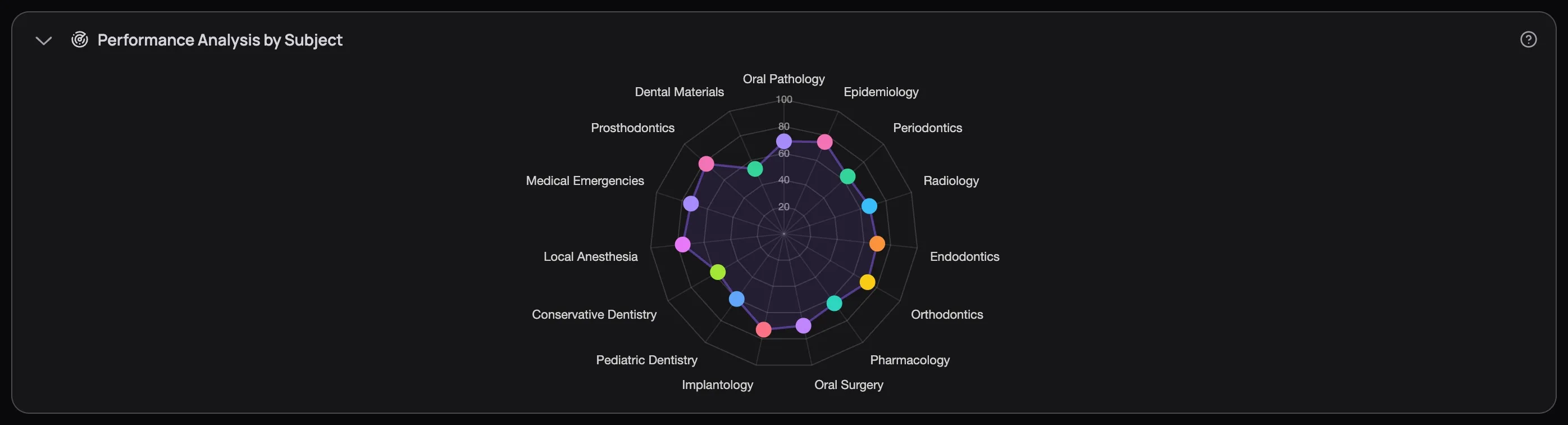
When to use it: Your radar chart has two or three subjects pulling inward — the dents you can't ignore. Those subjects are dragging your average down and you need concentrated reps on exactly those topics.
Setup:
- Questions: 40–50
- Difficulty: Mixed (or Easy if your weak subject is below 50%)
- Subjects: 2–3 weak subjects at heavy weight, 1–2 stronger subjects for balance
Example: Your radar chart shows Pharmacology at 42% and Endodontics at 51%. Everything else is above 70%.
| Subject | Weight | Why |
|---|---|---|
| Pharmacology | 40% | Deepest dent — maximum reps |
| Endodontics | 35% | Second priority |
| Oral Pathology | 15% | Strong subject — keeps it fresh |
| Dental Materials | 10% | Maintenance |
After the mock: Open your results, filter by Incorrect, and spend as much time reviewing as you spent taking the mock. A 40-minute mock deserves 40 minutes of review. The wrong-answer explanations teach you where similar concepts diverge — which is exactly what trips you up on exam day. Bookmark anything that genuinely surprised you.
"Week 3 — Pharma & Endo Attack (Mixed)" tells you everything. "Mock 7" tells you nothing. When you have fifteen mocks in your library, clear names save you from clicking into each one to remember what it was for.
Blueprint Simulation
When to use it: You're 3–4 weeks from your exam and need to practice under realistic conditions. You've addressed your worst subjects and want to test how you perform across the full exam scope.
Setup:
- Questions: 75–100 (the builder caps at 100 — use that for full simulations)
- Difficulty: Mixed
- Subjects: All subjects for your exam, weighted to approximate the official blueprint
The tricky part is translating your exam's official blueprint into QuizOdontist subjects. The NDEB, JCNDE, and ADA each structure their blueprints differently — by content areas, foundation knowledge domains, or sections — and those categories don't always map one-to-one to our subjects. We've done the translation for you.
AFK Blueprint → QuizOdontist Distribution
The NDEB's AFK blueprint has 9 content areas. The largest — Applied Biomedical Sciences at 20% — doesn't have a standalone QuizOdontist subject. That's deliberate: we integrate biomedical concepts (anatomy, biochemistry, histology, microbiology) into clinical subject questions, because that's how the AFK actually tests them. A question about the mechanism of lidocaine is both pharmacology and biomedical science. A question about ameloblastoma histology is both oral pathology and biomedical science.
The distribution below accounts for this by weighting subjects that carry heavier biomedical content — Oral Pathology, Pharmacology, Dental Materials, Periodontics — above their pure clinical allocation.
| QO Subject | Target % | NDEB Content Area (% ±5%) |
|---|---|---|
| Oral Pathology | 12% | Oral Med/Path/Radiology (15%) + biomedical histopathology |
| Pharmacology | 10% | Pharma/Anesthesia/Emergencies (14%) + biomedical biochemistry |
| Periodontics | 10% | Periodontics (8%) + biomedical microbiology/immunology |
| Dental Materials | 8% | Applied Biomedical Sciences (20%) — material science |
| Oral Surgery | 8% | Oral Surgery/Trauma (8%) |
| Conservative Dentistry | 7% | Restorative/Prostho/Implants (16%) |
| Radiology | 7% | Oral Med/Path/Radiology (15%) |
| Prosthodontics | 6% | Restorative/Prostho/Implants (16%) |
| Endodontics | 6% | Endodontics (6%) |
| Local Anesthesia | 5% | Pharma/Anesthesia/Emergencies (14%) |
| Epidemiology | 5% | EBD/Prevention/Ethics (5%) |
| Implantology | 4% | Restorative/Prostho/Implants (16%) |
| Orthodontics | 4% | Ortho/Pedo/Geriatric (8%) |
| Pediatric Dentistry | 4% | Ortho/Pedo/Geriatric (8%) |
| Medical Emergencies | 4% | Pharma/Anesthesia/Emergencies (14%) |
Every NDEB content area carries a ±5% variance — the actual exam can shift by up to 10 questions in either direction from the published target. A Pharmacology-heavy sitting might allocate 38 questions to Content Area 4; a light one might have 18. You can't predict which version you'll get, so these distributions aim for the midpoint. Don't agonize over 2% differences — the exam itself doesn't hold to exact numbers either.
INBDE Blueprint → QuizOdontist Distribution
The INBDE blueprint works differently from the AFK. Instead of clinical subject areas, it uses 10 Foundation Knowledge (FK) domains — anatomy (FK1), physics for biology (FK2), materials science (FK3), developmental diseases (FK4), immunology (FK5), pathology (FK6), microbiology (FK7), pharmacology (FK8), behavioral sciences/ethics (FK9), and research/biostatistics (FK10) — that cross-cut 3 Clinical Content sections. A single INBDE question might test anatomy, pathology, and treatment planning simultaneously.
QuizOdontist's 11 INBDE subjects are structured to mirror this integration. Pathology carries the most weight because it draws from four FK domains at once — developmental diseases, immune defense, general pathology, and microbiology. Subjects like Pharmacology and Biostatistics map more directly to a single FK domain each.
| QO Subject | Target % | What It Covers |
|---|---|---|
| Pathology | 18% | General/oral pathology, microbiology, immunology, developmental diseases |
| Anatomic Sciences | 12% | Gross anatomy, histology, embryology, physiology, biochemistry |
| Pharmacology | 11% | Drug mechanisms, interactions, prescribing, therapeutics |
| Biostatistics | 10% | Research methodology, study design, statistical analysis, informatics |
| Ethics & Patient Management | 10% | Behavioral sciences, ethics, jurisprudence, patient communication |
| Restorative Dentistry | 9% | Materials science, operative procedures, prosthodontics |
| Diagnosis & Radiology | 8% | Radiographic interpretation, diagnostic reasoning, treatment planning |
| Pediatrics & Orthodontics | 6% | Developmental conditions, growth, pediatric management, malocclusion |
| Periodontics | 6% | Periodontal disease, immune response, microbiology in perio context |
| Endodontics | 5% | Pulpal/periapical disease, root canal procedures |
| Oral Surgery | 5% | Extractions, surgical management, trauma |
The published FK percentages don't carry an explicit ±variance like the AFK, but with 500 questions across 7 sections, natural exam-to-exam variation is built in. These targets give you the right proportions — small deviations won't matter across a 100-question simulation.
ADAT Blueprint → QuizOdontist Distribution
The ADAT has the most straightforward structure: three sections with fixed question counts — Biomedical Sciences (80 questions, 40%), Clinical Sciences (80 questions, 40%), and Data/Research/EBD (40 questions, 20%). The clinical section directly names the specialties, so the mapping to QuizOdontist subjects is clean.
The within-section distribution across topics isn't published by the ADA, but the Biomedical Sciences section splits roughly equally across its four domains (~20 questions each).
| QO Subject | Target % | ADAT Section |
|---|---|---|
| Anatomic Sciences | 10% | Biomedical — Anatomic Sciences |
| Microbiology & Pathology | 10% | Biomedical — Microbiology/Pathology |
| Dental Anatomy & Occlusion | 10% | Biomedical — Dental Anatomy |
| Pharmacology | 8% | Biomedical (biochem/physiology) + Clinical |
| Biostatistics | 10% | Data/Research/EBD (20%) |
| Ethics & Patient Management | 10% | Data/Research/EBD + Clinical ethics |
| Periodontics | 7% | Clinical Sciences |
| Endodontics | 6% | Clinical Sciences |
| Prosthodontics | 5% | Clinical Sciences |
| Operative Dentistry | 5% | Clinical Sciences |
| Oral Surgery | 5% | Clinical Sciences |
| Orthodontics | 4% | Clinical Sciences |
| Pediatric Dentistry | 4% | Clinical Sciences |
| Pain Control & Anesthesia | 3% | Clinical Sciences |
| Oral Diagnosis & Radiology | 3% | Clinical Sciences |
The three ADAT sections always have 80/80/40 questions. The within-section topic distribution isn't officially published, so the Clinical Sciences percentages above are our best approximation based on the ADA's content specifications. The actual exam may vary.
The endurance factor
A Blueprint Simulation isn't just a knowledge test — it's a stamina test. The AFK is 200 questions across 4 hours. The INBDE is 500 across two days. The ADAT is 200 across 4.5 hours. If you can't sustain focus for 75 questions in a practice setting, you'll hit a wall on exam day. Start with 75-question simulations and build up to 100.
Blueprint Simulations are for candidates who've already addressed their major weak spots. Taking a full-length exam when three subjects are below 50% just confirms what you already know — and the 90 minutes you spent would've been better used on targeted Weakness Attacks.
Confidence Reset
When to use it: Your scores have been dropping, your motivation is tanking, and you need a psychological reset. This happens to everyone — usually around week 4–5 of prep when the initial momentum fades and the exam still feels far away.
Setup:
- Questions: 25–30
- Difficulty: Easy
- Subjects: Your two strongest subjects at 70–80%, third-strongest at 20–30%
The purpose: This isn't about learning new material. It's about reminding yourself that you do know things. A 25-question Easy mock on your strongest subjects takes 15 minutes and almost guarantees a score above 80%. That score resets the narrative in your head from "I'm failing" to "I'm solid in these areas and building in others."
Use it sparingly. One Confidence Reset per week at most. It's medicine, not a diet.
Candidates who burn out don't fail because they studied the wrong material. They fail because they stopped studying entirely. A Confidence Reset that keeps you going is worth more than a Hard mock that makes you quit.
Reality Check
When to use it: You've been scoring well on your mocks and want to know whether your confidence is justified or whether you've been coasting at too easy a level.
Setup:
- Questions: 40–50
- Difficulty: Hard
- Subjects: 6–8 subjects, weighted toward the ones you think you've mastered
The purpose: This mock is designed to humble you. Hard questions require you to synthesise across concepts, apply knowledge to unfamiliar scenarios, and distinguish between very similar answers. If you score above 65% on a Hard mock across multiple subjects, your preparation is genuinely strong. If you score below 50%, the gap between what you know and what you can apply is wider than your Easy/Mixed scores suggested.
What to do with the results: Don't panic. A Reality Check score of 45% doesn't mean you're failing — it means your practice hasn't been pushing you hard enough. Shift your Weakness Attacks from Mixed to Medium difficulty. Add Hard questions gradually. Your difficulty analytics track the gap between Easy and Hard scores over time — that gap should be narrowing.
Free accounts can select up to 5 subjects per custom mock. That's enough for Weakness Attacks (2–3 weak + 1–2 maintenance) and Confidence Resets. For Blueprint Simulations across all subjects, you'll need a Premium plan.
Let the AI Tell You What to Build
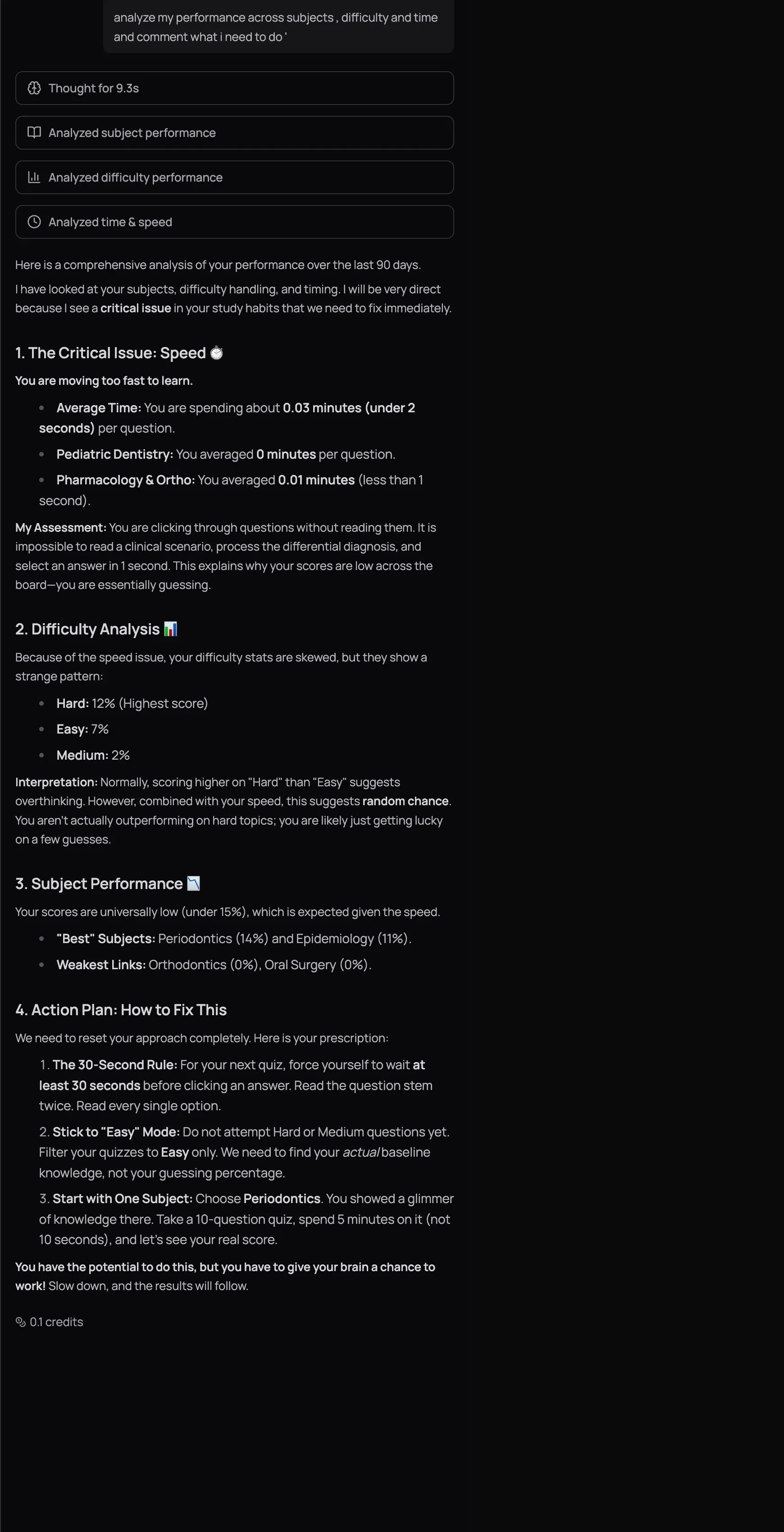
You don't have to figure out which archetype to use on your own. The AI Tutor has access to your quiz history, subject accuracy, difficulty breakdown, and pacing data. Ask it directly and it runs multiple analytics tools on your data before responding with a structured plan:
Here are prompts that work well:
- "What should my next custom mock look like?" — it'll suggest subjects, percentages, and difficulty based on your current weak spots.
- "Which subjects should I focus on this week?" — it runs your analytics and tells you where the biggest gaps are.
- "I scored 52% on Pharmacology and 78% on Oral Pathology. Should I do a Weakness Attack or a Reality Check?" — it'll recommend the right archetype for your situation.
- "Am I ready for a Blueprint Simulation?" — it checks whether your weak subjects have improved enough to shift from targeted practice to full-scope endurance.
This is faster than reading four charts yourself, and the AI catches patterns you'd miss — like scoring higher on Hard than Medium (a sign of careless mistakes on easier material), or a strong subject that's quietly been declining over the past two weeks.
Build the habit: before you create a mock, ask the AI what to put in it. It takes 30 seconds and it's working off more data than you can eyeball from a dashboard.
MCQs Every Day — No Exceptions
Here's a trap that's easy to fall into: spending most of your prep time reading — Learning Centre lessons, textbook chapters, notes — and leaving MCQ practice for "when you feel ready." They never feel ready. And when they finally take a mock two weeks before the exam, they discover that knowing a concept and answering an MCQ about it are completely different skills.
You can't win a football World Cup by practising swimming. These exams are MCQ-based. Nobody is going to ask you to write an essay on the coagulation cascade. They're going to give you a patient scenario, four plausible answers, and 90 seconds. The only way to get good at that is to do it — every single day.
Reading and MCQ practice aren't sequential phases. They run in parallel from day one. Even on days when you're covering new material in the Learning Centre, end the session with at least a short mock on that subject. The reading teaches you the concept. The MCQ teaches you how the exam will twist it.
A Realistic Study Day
These exams cover 11–15 subjects of real depth. The syllabus is vast — there's no shortcut through it. Here's how a full study day might look with mocks as the backbone:
| Block | Activity | Time |
|---|---|---|
| Morning | Dashboard check or ask the AI Tutor: "What should I focus on today?" | 5 min |
| Morning | Learning Centre — read lessons on 1–2 subjects, work through flashcards | 60–90 min |
| Morning | Weakness Attack on those same subjects — apply what you just read | 40 min mock + 40 min review |
| Break | Step away. Your brain consolidates during rest, not during grinding. | 30 min |
| Afternoon | Learning Centre — second subject block | 60–90 min |
| Afternoon | Second Weakness Attack or Subject Mock — different subjects from the morning | 40 min mock + 40 min review |
| Evening | Bookmark review + AI Tutor to break through concepts from today's wrong answers | 30–45 min |
That's roughly 5–6 hours. On weekends, replace one of the Weakness Attacks with a Blueprint Simulation (90 min) every two weeks. Swap in a Reality Check every 2–3 weeks. Drop in a Confidence Reset whenever motivation dips.
Adapt the structure to your life — clinic days, work, family. Some days you'll only get 2 hours. On those days, skip the reading and do one mock with full review. The mock is the non-negotiable part. Reading without practice builds false confidence. Practice without reading still builds real exam skills.
If you spent three hours in the Learning Centre and zero minutes on MCQs, you studied for zero minutes. Reading creates recognition — you see a concept on the page and think "I know this." MCQs test retrieval — you pull the concept from memory under pressure with four distractors trying to trip you up. Recognition and retrieval are different skills. The exam tests retrieval. Practice retrieval.
If you spent 40 minutes taking a mock and 5 minutes glancing at results, you did the easy part and skipped the part that actually moves your score. Match your review time to your mock time.
Common Mistakes
Using the same distribution every week. Your weak subjects change as you study. Pharmacology at 42% three weeks ago might be at 68% now — and Oral Surgery, which you ignored, has quietly become your new worst subject. Check your radar chart before building each week's mocks. If you're still using the same distribution from week one, you're studying last month's problems.
Only taking long mocks. A 100-question mock takes 90 minutes. By question 60, you're fatigued and making careless mistakes that have nothing to do with knowledge. Those mistakes skew your analytics. Shorter mocks (30–50 questions) with full review are more efficient for learning. Save the 100-question simulations for when you're specifically training endurance.
Skipping the review. Taking a mock without reviewing it is like taking a blood test and throwing away the results. The score tells you almost nothing. The explanations — especially the wrong-answer explanations — tell you everything.
Never changing difficulty. If you've been on Mixed for six weeks and your scores are consistently above 80%, you're coasting. Step up. Conversely, if you jumped straight to Hard and you're below 50%, you skipped steps. Drop back to Mixed and build the foundation first.
When to Change Course
Five signals that it's time to change what you're doing:
A radar dent is filling in. Your targeted subject jumped from 45% to 72% over two weeks. Reduce its weight in your mocks and redirect attention to the next-deepest dent. Don't keep hammering a subject that's already improving — diminishing returns are real.
Your trend line has been flat for 10+ quizzes. Whatever you're doing has stopped working. Common causes: repeating the same difficulty level without stepping up, grinding quizzes without spending equal time on review, or never using the AI Tutor to break through concepts that won't stick from explanations alone.
A strong subject is declining. If Oral Pathology was at 85% and has dropped to 70%, your other study priorities have crowded it out. Add it back into your Weakness Attack at 10–15% for maintenance.
Your box plots are getting narrower. This is a quiet win most people miss. Narrow box plots mean consistent performance — you're not swinging between 50% and 90% anymore. Even if your average hasn't moved much, consistency means your knowledge is solidifying. Keep going.
You're in Mastery zone for 3+ subjects. Check your scatter plot. If most dots cluster in the fast-and-accurate zone across multiple subjects, you're past the targeted practice phase. Shift to Blueprint Simulations. Your prep is now about stamina and integration, not individual subject gaps.
How to Know It's Working
Three signals that your mock strategy is doing its job:
-
Your radar chart is becoming more circular. The subjects you've been targeting with Weakness Attacks are climbing from the 40s into the 60s, then the 70s. If a dent hasn't moved after two weeks of targeted mocks, the problem isn't more quizzes — it's going back to the Learning Centre or AI Tutor to understand the concepts behind the questions.
-
Your difficulty gap is narrowing. The difference between your Easy and Hard scores is shrinking. When your Easy is 85% and your Hard is 65%, you're applying knowledge — not just recognising it.
-
You're bookmarking fewer questions per mock. Early in prep, you'll bookmark 10–15 questions per mock. By week 6, that should drop to 3–5. If you're still bookmarking the same concepts, the explanations aren't landing — ask the AI Tutor to explain them from a different angle.
Next Up
You've built mocks to close your gaps. Now you need study aids that make the material stick — mnemonics, comparison tables, and concept summaries you can revise from in the final weeks. Read AI-Powered Study Notes.