You can't test your way to knowledge.
Ten thousand practice questions won't teach you pharmacology if you haven't studied pharmacology. They'll just show you — ten thousand times — that you don't know pharmacology. An ITD who hasn't cracked a biochemistry textbook in eight years doesn't need more questions. A dental student seeing a forest plot for the first time doesn't need more questions. They need to actually learn the material first.
The Learning Centre is where that happens. Every subject, every module, every lesson — structured around one idea: learn it, then test it. Not the other way around.
Learn It, Then Test It
Every lesson in the Learning Centre follows the same loop: read → recall → test.
Read the material. Try to retrieve it from memory with flashcards. Then prove you know it with a quiz. That sequence isn't random — it's the difference between "I've seen this before" and "I actually know this." You remember what you struggle to pull from memory, not what you passively highlight.
We built the entire Learning Centre around this loop because smart dentists still fail these exams all the time. They know how to treat patients. They don't know how to pass a standardized test. Different skill. The Learning Centre trains the second one.
How It's Organized
Three levels. Simple hierarchy. No nesting nightmares.
Subjects → Modules → Lessons
Subjects
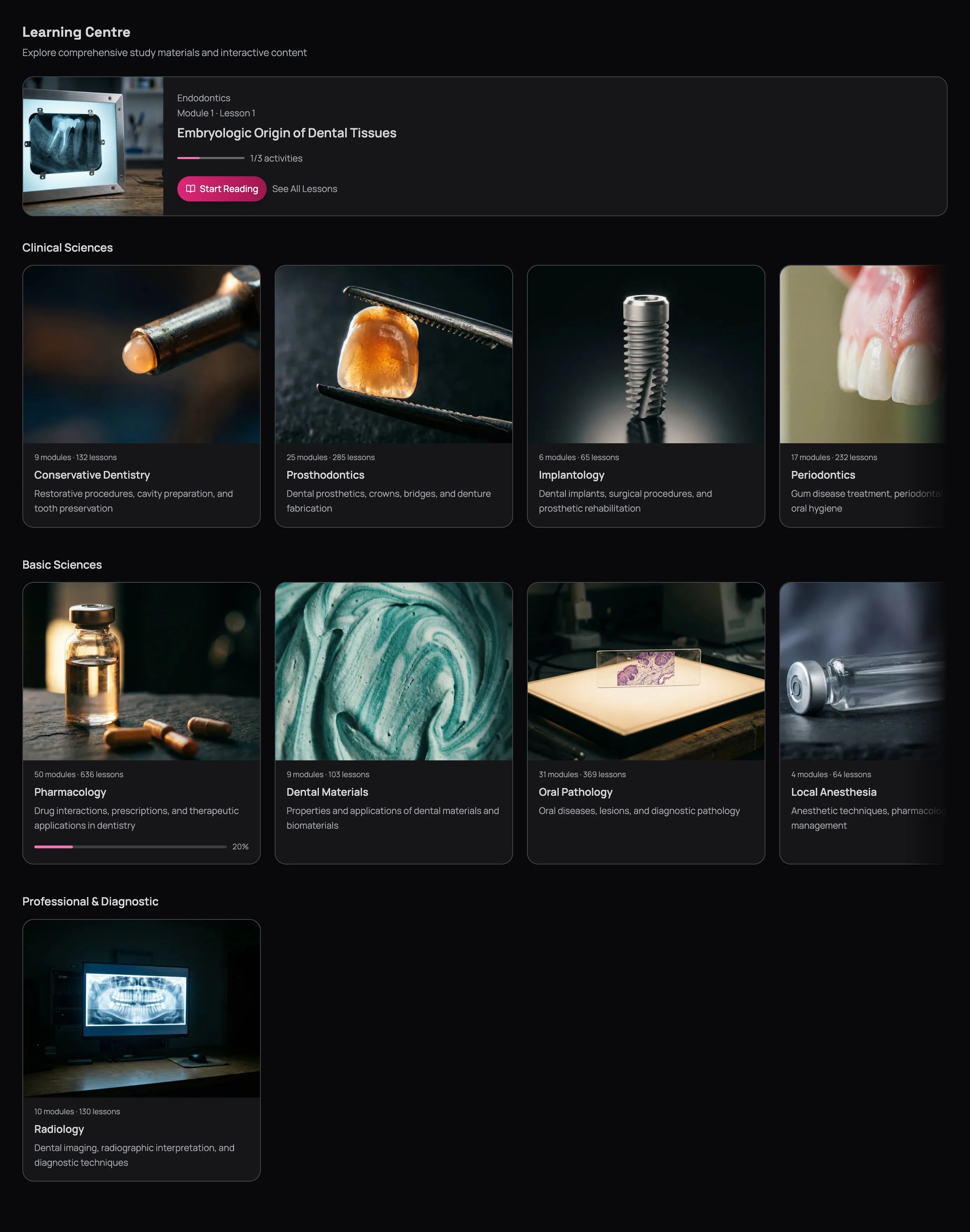
When you open the Learning Centre, you see your subjects organized into three categories:
- Clinical Sciences — Prosthodontics, Periodontics, Endodontics, Oral Surgery, Pediatric Dentistry, Orthodontics, Operative Dentistry. The clinical bread and butter.
- Basic Sciences — Anatomy, Biochemistry, Microbiology, Pharmacology, Dental Materials, Pathology, Histology. The stuff that made you question your career choice in first year.
- Professional & Diagnostic — Ethics & Jurisprudence, Radiology, Biostatistics, Pain & Anxiety Management. The subjects everyone underestimates until exam day.
Each subject card shows your progress percentage, total lessons, and total modules. The progress bar fills based on lessons you've actually completed — not opened, not scrolled through, not left open in a tab while you watched Netflix. Completed.
AFK candidates see a different subject lineup than INBDE or ADAT candidates. The content is scoped to your exam's blueprint. If you don't see a subject you expected, check that you've selected the right exam — see Choosing Your Exam.
Modules
Click into a subject and it breaks into modules — logical groupings of related lessons. Endodontics, for example, has modules like "Pulp Biology and Histology," "Root Canal Morphology," and "Irrigation and Disinfection." Each module is a coherent unit you can complete in one or two study sessions.
Lessons
Each lesson covers one concept. Not a chapter. Not an overview. One focused topic.
"Vertucci's Classification of Root Canal Systems" is a lesson. "All of Endodontics" is not.
This granularity is deliberate. When you get a quiz question wrong about root canal morphology, you don't wade through a 40-page chapter hunting for the relevant paragraph. You go back to the exact lesson, re-read the specific content, and close the gap. That's the difference between studying smart and studying hard.
The Three Activities
Every lesson has three activities, and the order isn't optional:
Reading — encode the information
The core content. Key terms highlighted, annotations available, notes editor built in. This is where you load the information into your brain for the first time. Read actively — don't let your eyes glaze. For the full breakdown of how readings work, see Reading Lessons.
Flashcards — practice retrieval
Active recall cards tied to the lesson's key concepts. Try to answer each one in your head before revealing. The struggle is the point — that's your brain forming stronger memory traces. Star the ones you got wrong; they'll land in your Bookmarks for spaced review later.
Pop Quiz — test under exam conditions
3–6 MCQ questions in the same format as your actual exam. Read every explanation — even for questions you got right. The explanations often contain nuance the reading didn't emphasize.
It's tempting. Everyone wants to jump straight to questions. But testing yourself on material you haven't encoded yet isn't studying — it's guessing. Read first. Recall second. Test third. This sequence is why the Learning Centre works.
For the deep dive on flashcards and pop quizzes — including why struggle matters and how to use starred cards — see Flashcards & Pop Quizzes.
Progress That Means Something
Progress is tracked at every level, and it's honest:
- Lesson level — each activity (reading, flashcards, quiz) can be marked complete independently
- Module level — shows completed lessons out of total
- Subject level — the progress bar reflects actual lesson completions, not time spent
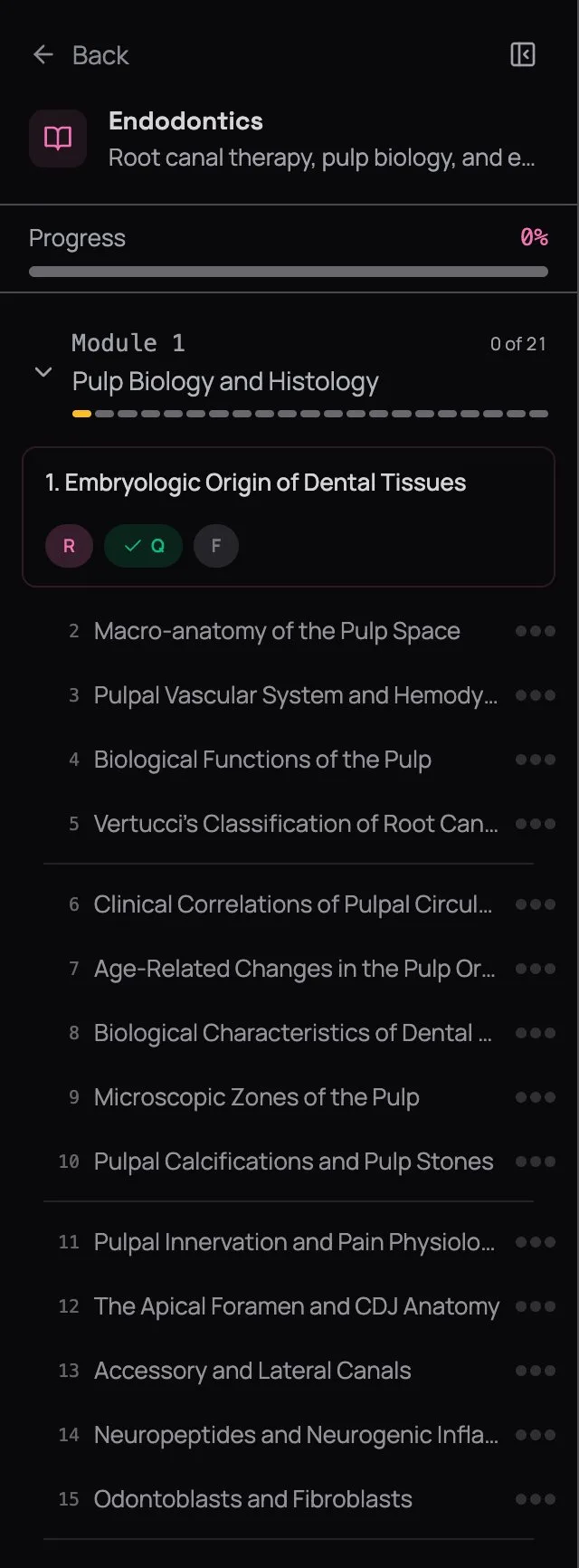
Each subject shows your completion percentage, the number of modules, and individual lessons within each module. The progress bar fills as you complete lessons — readings, flashcards, and pop quizzes all count.
The colored dots next to each lesson tell you what you've done: R for reading, Q for quiz, F for flashcards. At a glance, you can see exactly which activities you've finished and which are still waiting.
If a lesson shows R and Q but no F, you skipped the flashcards. That's your gap. Go back and close it.
Continue Learning
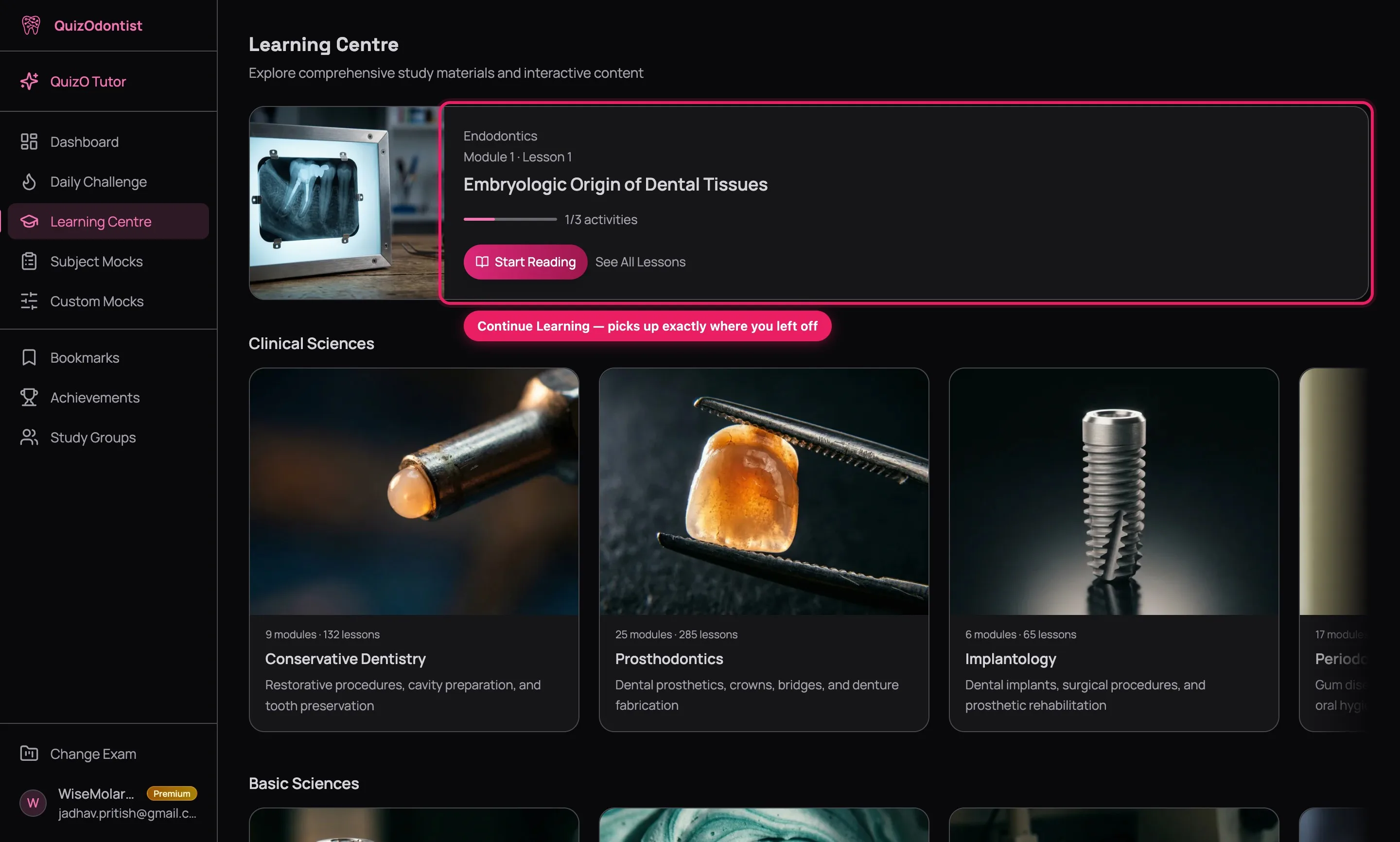
When you come back tomorrow — and you should come back tomorrow — the Continue Learning card at the top of the Learning Centre shows your most recently active subject and the exact lesson you were working on. One click and you're back in it.
What to Study First
Not every subject carries the same weight on your exam. Spreading yourself thin across 15 subjects simultaneously is the most common mistake we see.
Here's the framework:
- Tier 1 — High weight: Pharmacology, Pathology, Anatomy, Biochemistry. These appear heavily on every dental licensing exam. If your Tier 1 subjects aren't above 80%, nothing else matters yet.
- Tier 2 — Medium weight: Clinical subjects like Prosthodontics, Periodontics, Endodontics, Oral Surgery. Tested substantially, often more straightforward recall than Tier 1.
- Tier 3 — Lower weight but free points: Biostatistics, Ethics, Radiology. Fewer questions, but they're predictable. Candidates who study these strategically pick up points others leave on the table.
Everyone knows Pharmacology is important. Everyone also hates studying it. The result? Candidates spend weeks on subjects they find interesting (Oral Surgery, Prosthodontics) and keep pushing Pharmacology to "next week." If this sounds familiar, read The AFK Cheat Code — it's about breaking exactly this pattern.
The smart play: get your Tier 1 subjects solid first. Then build out Tier 2. Then polish Tier 3. Your analytics tabs will show you exactly where your gaps are — use them.
What It Feels Like
Here's what nobody tells you about studying for these exams: the first two months are brutal.
The syllabus is enormous. You're staring at 15+ subjects, hundreds of lessons, and a progress bar that's barely moved. The routine isn't set yet. The habit hasn't formed. And if you're an ITD who's been practicing for years, you're not just learning — you're relearning how to be a student again. How to sit down, focus on a textbook, and retain information you last saw in dental school a decade ago.
You'll open Microbiology, do the flashcards, and get half of them wrong. You'll take the pop quiz and score 40%. You'll close the app and wonder if this is even possible.
It is. That's the process working.
The flashcards you got wrong? Those are the ones your brain is actively consolidating. The quiz questions you missed? The explanations stick harder than any textbook paragraph because you just felt the gap firsthand. That discomfort isn't failure — it's the mechanism.
Around month two, something shifts. The flashcards start clicking before you flip them. You recognize bacterial classifications and virulence factors, not because you memorized a list, but because you've retrieved them enough times that they're yours now. Pop quiz scores creep from 40% to 65% to 80%. Subjects you dreaded start feeling manageable.
Not easy. Manageable. And that's everything — because the candidates who pass aren't the ones who found it easy. They're the ones who kept going when it wasn't.
The Learning Centre isn't designed to feel good on day one. It's designed to make you dangerous on exam day.
What's Next
Dive into the details:
- Reading Lessons — how to work through content, use annotations, and take notes
- Flashcards & Pop Quizzes — active recall tools and why productive struggle is the point
Once you've built a foundation, test yourself for real with Practice Quizzes — or build targeted exams with the Custom Mock Builder.