Pick the wrong exam and you'll spend months preparing for something that doesn't move your career forward. Pick the right one and every hour of study counts toward a specific seat, a specific license, a specific future.
This isn't a minor settings toggle. Your exam choice filters the entire platform — quizzes, lessons, mocks, AI tutor responses, everything. So let's make sure you pick right.
The Three Exams
AFK — Assessment of Fundamental Knowledge
The exam that breaks people.
The AFK is the first written hurdle in Canada's NDEB equivalency process for internationally trained dentists. It tests foundational dental science — pharmacology, microbiology, biochemistry, anatomy, pathology, dental materials — across 200 multiple-choice questions under time pressure.
The first-attempt pass rate? Around 33%. Two out of three candidates fail. Not because they're bad dentists — most have years of clinical experience. They fail because the AFK tests textbook recall across 15+ subjects, and most ITDs haven't cracked a textbook since dental school.
It's testing whether you remember enough foundational science to continue through the equivalency process. That's a different skill than treating patients. If you're wondering why experienced dentists struggle with it, we wrote a whole piece on it: Why Smart Internationally Trained Dentists Fail AFK.
Format: 200 standalone MCQs, single best answer, timed. No patient cases — just raw knowledge recall.
If you're an ITD headed for Canada, this is your exam. For the full licensing roadmap beyond the AFK — including the ACJ and clinical exams — read The Ultimate Guide to the NDEB Equivalency Process.
INBDE — Integrated National Board Dental Examination
The two-day marathon.
The INBDE replaced the old Part I and Part II board exams and is required for dental licensure in every US jurisdiction. Every student at a CODA-accredited dental school takes it — but they're not the only ones. Internationally trained dentists pursuing US licensure must pass the INBDE too, whether they're going through an advanced standing program or a direct licensure pathway.
Unlike the AFK, the INBDE doesn't test subjects in isolation. You won't get a "pharmacology section." You'll get a patient scenario where the answer requires you to pull from pharmacology, pathology, and treatment planning simultaneously. That integration is what makes it tricky — knowing the facts isn't enough. You have to find them inside a wall of clinical noise, under a ticking clock.
360 questions on Day 1. 140 on Day 2. Most candidates prepare for the content. Almost nobody prepares for what it feels like to come back on Day 2.
Format: ~500 questions across two days. Mix of standalone MCQs, patient case-based testlets, and integrated scenarios.
If you want to understand how the questions actually work — the patient boxes, the noise, the time traps — read INBDE Practice Questions: Decode the Format.
ADAT — Advanced Dental Admission Test
Two audiences, one exam.
Most people think ADAT is only for specialty residencies — orthodontics, oral surgery, periodontics, endodontics. And yes, many programs use your ADAT score to decide who gets in. But there's a second audience that's just as large: internationally trained dentists applying to advanced standing DDS/DMD programs in the US. These compressed programs (typically 2–2.5 years) let ITDs earn a US dental degree by entering at the third year of a regular DDS curriculum. Schools like Columbia, USC, and NYU use ADAT scores as a major admissions factor.
The ADAT covers biomedical and clinical sciences at a higher level than the INBDE, plus research interpretation.
Here's the thing most people don't realize: whether you even need the ADAT depends entirely on where you're applying. Some US specialty residencies don't require it. Canadian programs like McGill and U of T? It's 70% of your application. Advanced standing programs? Check each school's requirements — some require it, others don't.
Format: 200 MCQs, computer-based, timed. Standalone questions — no testlets.
If you're an ITD debating between AFK and ADAT, the answer depends on your pathway. We broke that decision down in detail: AFK vs ADAT: Which Exam Do You Actually Need?
Side-by-Side Comparison
| AFK | INBDE | ADAT | |
|---|---|---|---|
| Country | Canada | United States | US & Canada |
| Who takes it | Internationally trained dentists | US dental students + ITDs seeking US licensure | Specialty + advanced standing applicants |
| Purpose | NDEB equivalency — first written exam | US dental licensure | Residency + advanced standing admissions |
| Questions | ~200 MCQ | ~500 MCQ (2 days) | ~200 MCQ |
| Question style | Standalone recall | Integrated patient cases | Standalone, higher level |
| Pass rate | ~33% first attempt | ~90%+ | Varies by program |
| Frequency | 2–3x per year | Year-round | Year-round |
| The hard part | Sheer breadth of subjects | Integration under time pressure | Depth of specialty knowledge |
Selecting Your Exam in the App
During onboarding
When you create your account, the onboarding flow asks you to pick AFK, INBDE, or ADAT. This sets your default and filters everything — quizzes, lessons, daily challenges, AI tutor context.
Anytime from the Exams page
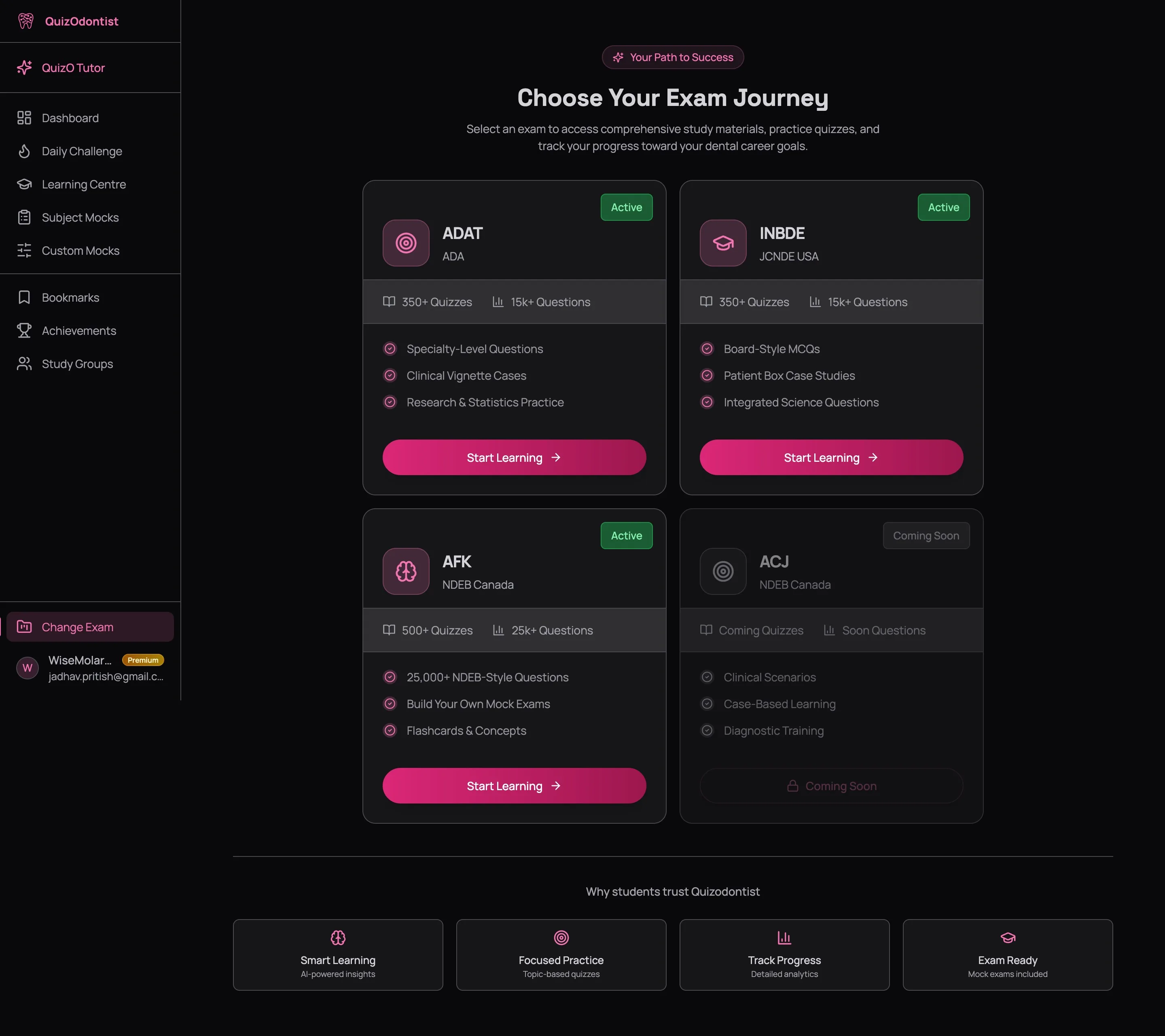
Already signed up? Open the Exams page from the sidebar. You'll see all three exams with descriptions. Click the one you want.
What Changes When You Pick an Exam
This isn't cosmetic. Your selection reshapes the platform:
- Learning Centre — Only subjects mapped to your exam's blueprint appear. AFK candidates won't see INBDE biostatistics modules, and vice versa.
- Practice Quizzes — The question bank filters to your exam. AFK has 25,000+ questions across 15+ subjects. INBDE and ADAT each have 15,000+.
- Custom Mocks — Subject selection is scoped to your exam, so you can target your weak areas precisely.
- Daily Challenge — Questions pulled from your exam's pool.
- AI Tutor — QuizO frames explanations for your specific exam context. Ask about pharmacology as an AFK candidate and you'll get recall-focused answers. Ask the same question as an INBDE candidate and you'll get integrated clinical reasoning.
Pharmacology is pharmacology — but how it's tested varies dramatically. AFK wants you to recall drug classifications cold. INBDE buries pharmacology inside patient scenarios. ADAT expects you to reason at a specialty level. Your exam selection ensures the content matches what you'll actually face.
Switching Exams
Changed your mind? Taking a second exam? Go to the Exams page from the sidebar and switch. Your content filters update instantly, and your progress in the previous exam is saved — switch back anytime and pick up where you left off.
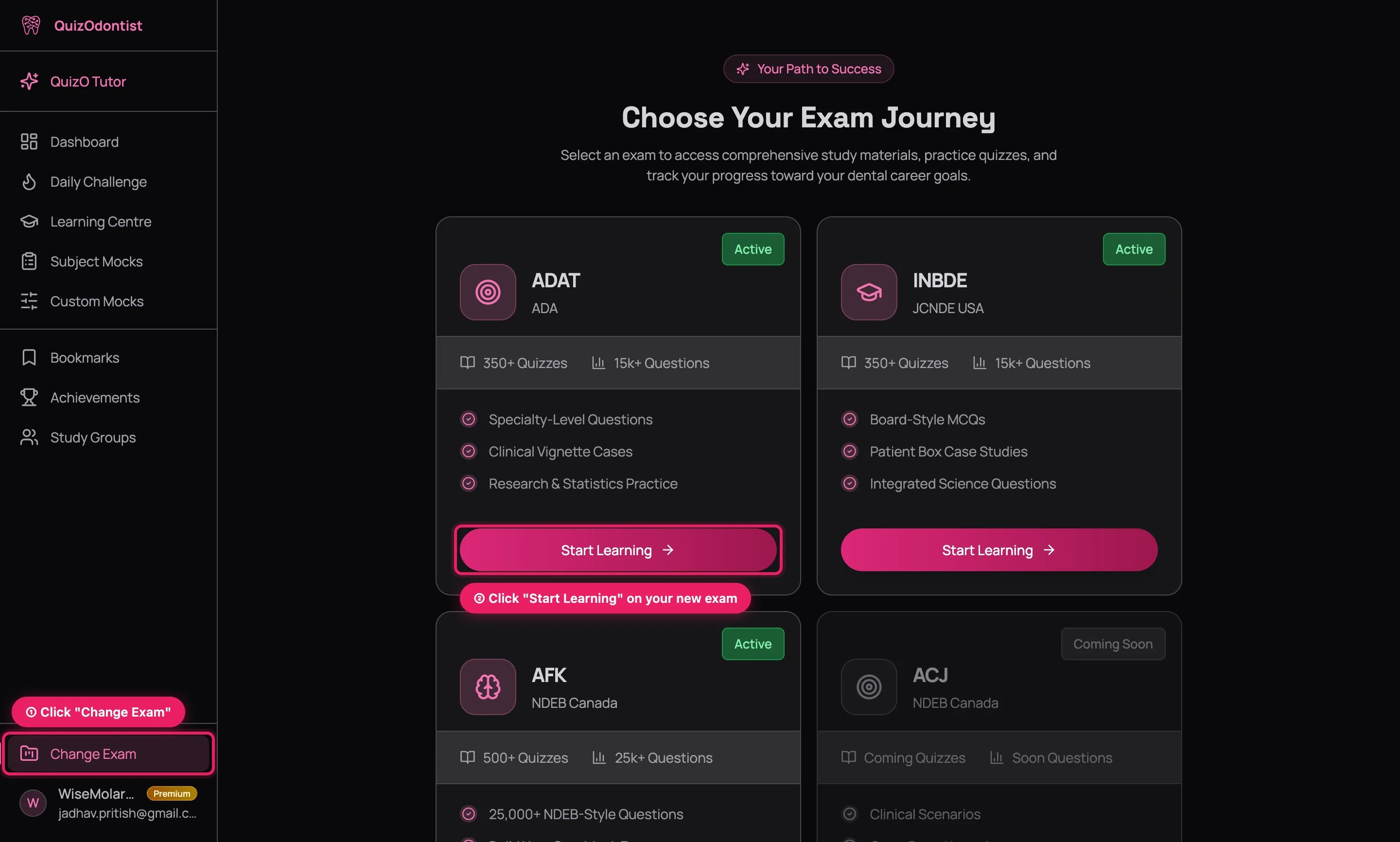
Some ITDs prepare for both the AFK and ADAT simultaneously — there's significant subject overlap. Switch between exams to access both question banks and both Learning Centre content sets. Progress is tracked independently for each. If you're weighing this strategy, read AFK vs ADAT: Which Exam Do You Actually Need? and U.S. vs Canada: Dental Licensure Pathways for ITDs.
Still Not Sure?
Quick decision tree:
- Internationally trained dentist → Canada → AFK. Start with the AFK prep guide.
- US dental student → boards for graduation → INBDE. Read the INBDE blueprint breakdown.
- ITD → US licensure → INBDE. You'll need it whether you're in an advanced standing program or pursuing direct licensure.
- Applying to specialty residency → ADAT. Check who actually needs it.
- ITD → advanced standing DDS/DMD in the US → ADAT (if required by your target schools) + INBDE (for licensure after graduation).
- ITD exploring both US and Canadian pathways → Start with whichever exam date comes first, then switch. Read the US vs Canada pathway comparison.
Now that you've picked your exam, head to the Learning Centre Overview to see how the study materials work — and how to use them to actually pass.