Every candidate bookmarks questions. Almost nobody uses those bookmarks well.
The typical pattern: you bomb an Oral Pathology quiz, flag 15 questions, feel productive. Next week, a rough Implantology mock — 20 more flags. By month two you have 140 saved items across 12 subjects. You open your bookmarks, see a wall of questions you vaguely remember getting wrong, feel overwhelmed, close the tab, and go take another quiz instead.
Those 140 bookmarks might as well not exist. And you just walked into the exam with 140 unresolved gaps.
A bookmark system works when it has one defining feature: it shrinks over time. Concepts you've mastered get cleared out. Ones that keep tripping you up get escalated to the AI Tutor for a different angle. By your final week, what's left is a tight, personal deck of the 15–20 concepts most likely to cost you points — and you've reviewed each one multiple times.
This tutorial builds that system.
What to Bookmark — and What Not To
The instinct is to bookmark everything you got wrong. Don't. A bookmark is not a trophy of failure. It's a commitment — you're saying "I will come back to this concept and learn it." If you commit to 140 things, you commit to nothing.
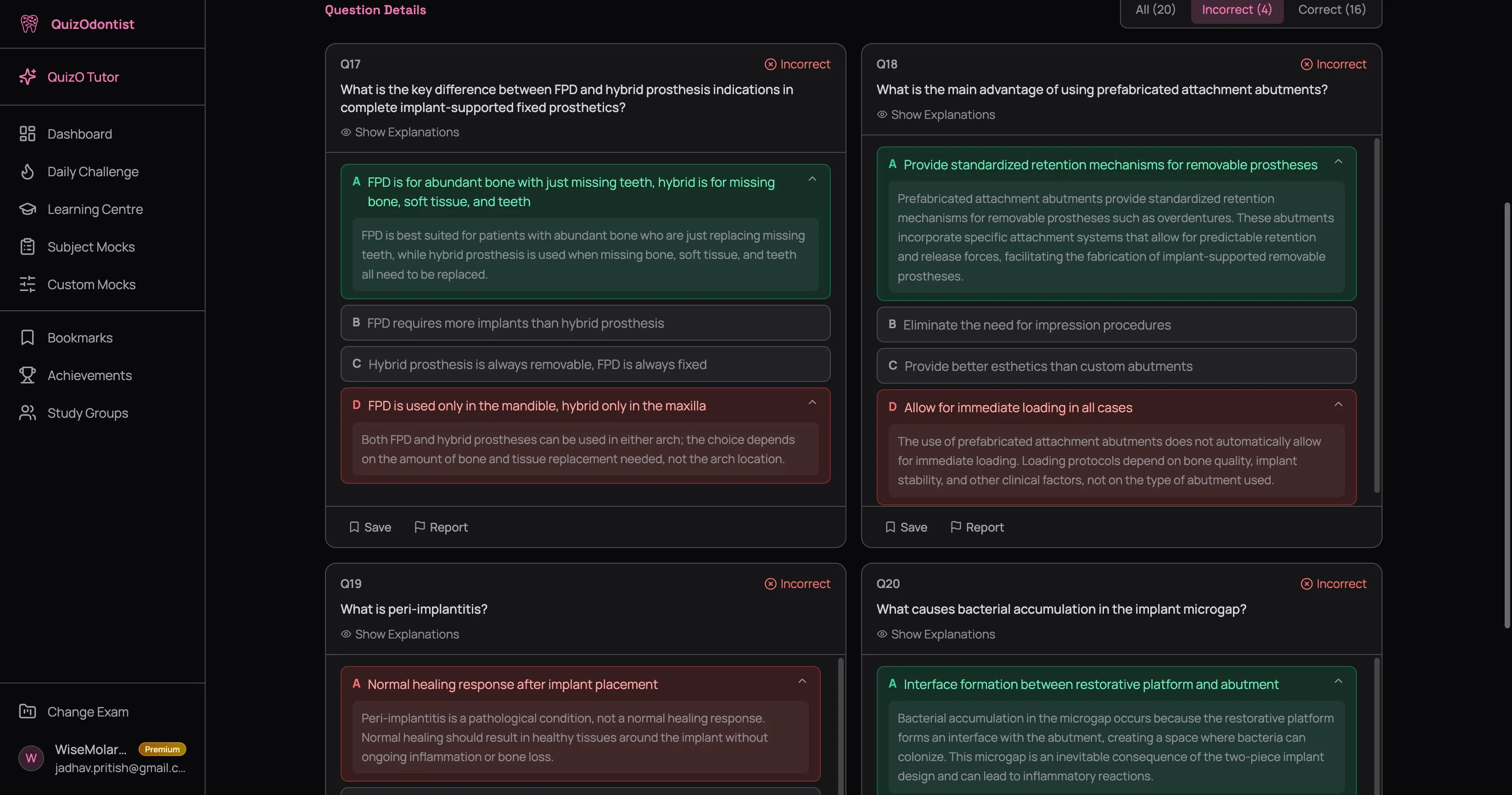
After finishing a quiz, open the results page and filter by Incorrect. Read the explanation for every missed question. Then decide using this rule:
If the explanation surprised you — if the correct answer wasn't what you expected even after thinking about it — bookmark it.
Don't bookmark:
- Questions you got wrong because you misread the stem or rushed through options. That's a pacing issue, not a knowledge gap.
- Questions where you guessed wrong between two options but the explanation immediately made sense. You'll get it next time without a bookmark.
- Questions on a subject you haven't studied yet. You don't need a bookmark to tell you that you don't know Orthodontics — your radar chart already says that. Bookmarks are for the concepts that surprised you within subjects you've studied.
Do bookmark:
- Questions where you were confident in your wrong answer. That's a misconception, not a gap — and misconceptions don't fix themselves.
- Questions where you read all four explanations and still don't fully understand why one is right. That's a concept you need to sit with.
- Flashcards you couldn't recall before flipping. During flashcard sessions, star any card where the answer didn't come. Starred flashcards automatically appear in your bookmarks.
Before you bookmark, ask yourself: "If this exact concept appeared in a different question tomorrow, would I get it right?" If the answer is no — bookmark it. If the answer is "probably, now that I've read the explanation" — skip it.
The Weekly Review
Once a week, open your Bookmarks page and enter Study Mode. Work through every saved item. For each one, try to recall the answer and the reasoning before revealing the explanation.
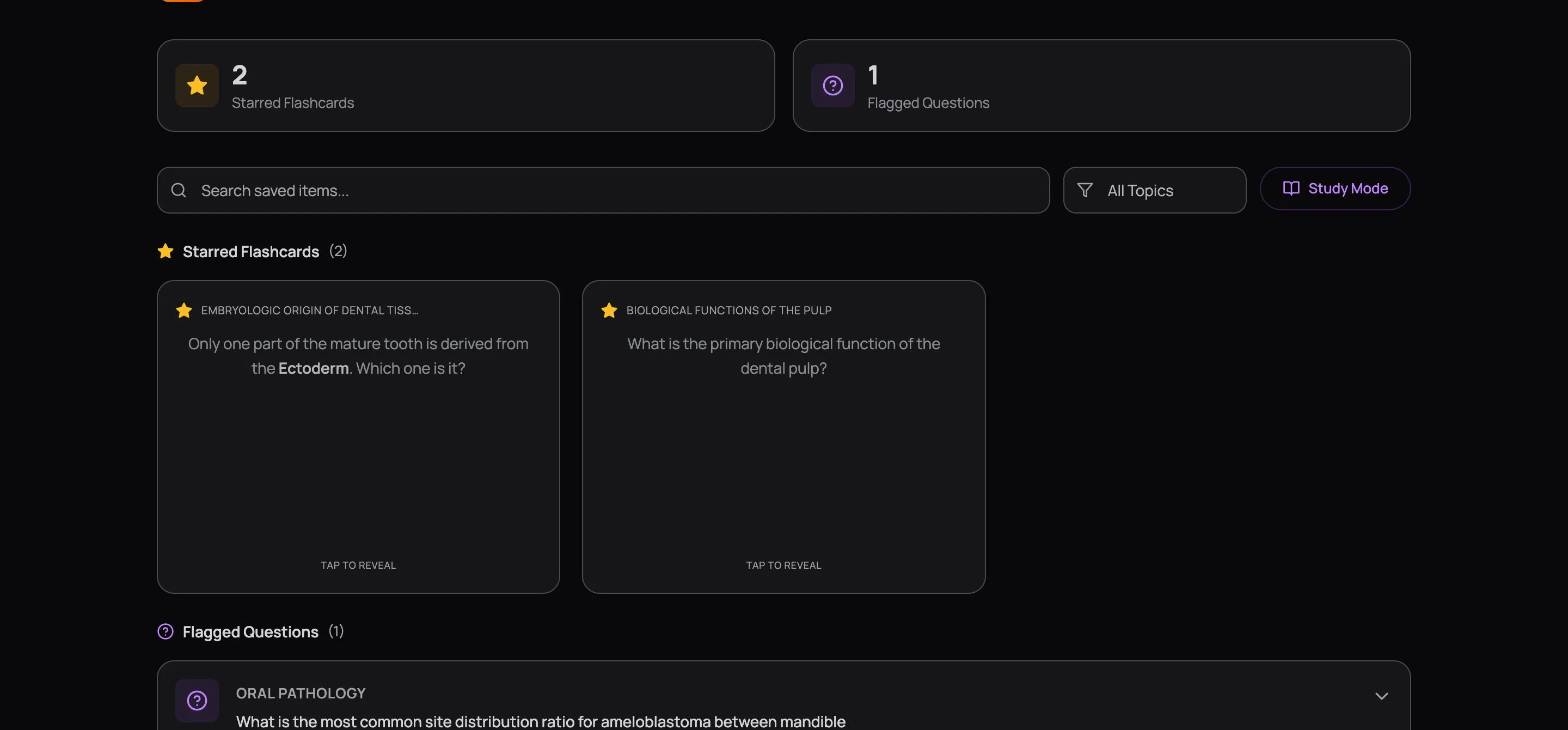
Look at the screenshot. Two starred flashcards — one asking which part of the mature tooth derives from ectoderm, another about the primary function of dental pulp. One flagged question about ameloblastoma site distribution between mandible and maxilla. Each one is a specific concept this candidate didn't know cold.
The review process has three outcomes for each item:
Clear it. If you can explain the answer, the reasoning, and why every other option is wrong — without looking — remove the bookmark. But not on the first successful recall. One hit could be recency — you reviewed it five minutes ago, of course it's fresh. Clear it only after you've nailed it in two consecutive review sessions. If you can explain it cold this Saturday and next Saturday, it's durable. That's when you clear it and make room.
Keep it. If you remembered the answer but couldn't fully explain the reasoning, it stays. Partial recall means it's not solid yet. Review it again next week.
Escalate it. If a bookmark has survived three or more review sessions and the concept still won't stick, rereading the same explanation won't help. You need a different angle. Open the AI Tutor and ask for one:
"I keep getting questions about ameloblastoma distribution wrong. I've read the explanation three times. Explain the mandible-to-maxilla ratio using a different approach — a clinical pattern, a developmental reason, anything that isn't the same stats I keep forgetting. Add it to my notes."
The AI reframes. Maybe the textbook explanation was histological and what you needed was a clinical pattern. Maybe you needed a mnemonic instead of a ratio. The AI-Powered Notes tutorial covers this escalation workflow in detail — the point here is that bookmarks are the trigger. Three strikes on the same concept = escalate, don't repeat.
The fastest path to recall is hearing the same concept explained three different ways — not hearing the same explanation three times. If the bookmark won't die after three reviews, the explanation isn't the right one for your brain. Ask the AI for a different angle, re-read the Learning Centre lesson, or ask a study group member how they remember it.
The Shrinking Principle
The trajectory below applies whether your prep is 8 weeks or 16. The phases are relative — what matters is the shape, not the calendar.
- First quarter of prep: Your collection grows fast. You're taking your first mocks, discovering gaps everywhere. 30–50 bookmarks is normal. Don't panic — this is the system doing its job. You're finding out what you don't know.
- Second quarter: Growth slows. Weekly reviews start clearing 5–10 items per session. New mocks still add some, but fewer concepts surprise you. Net count plateaus around 40–60.
- Third quarter: Shrinking begins. You've covered most subjects at least once. Your mocks produce fewer genuine surprises. Reviews clear more than you add. Count drops to 25–35.
- Final quarter: Your collection is tight. 15–25 items, each one reviewed across multiple sessions. These are your personal "most likely to lose a point" concepts — the ameloblastoma ratios, the stages of odontogenesis you keep misordering, the one local anaesthetic interaction you can't keep straight.
- Final week: 10–15 items. You review them daily. It takes 10 minutes. These are the last concepts standing between you and a clean exam.
If your collection is still growing past the halfway mark, one of two things is happening:
- You're not reviewing. Fix: commit to the weekly ritual. Twenty minutes once a week is all it takes.
- You're bookmarking too liberally. Fix: apply the surprise rule strictly. Careless errors and unstudied subjects don't get bookmarks. Only genuine conceptual gaps do.
Bookmarks as Mock Intelligence
Your bookmarks aren't just a review tool — they're intelligence for your mock strategy.
Filter your bookmarks by subject. If 12 of your 30 bookmarks are Endodontics questions, that tells you something your dashboard might not. Your Endodontics average might have climbed from 45% to 68% — the radar chart looks healthy — but 12 flagged concepts means you're still hitting surprises in that subject. The gaps are real. They're just hiding behind a rising average.
Your next Weakness Attack should include Endodontics — not because your average is low, but because your bookmark density says the concepts underneath are still shaky. Twelve flagged items in one subject is a louder signal than a radar chart dent.
This is the difference between studying from scores and studying from gaps. Scores tell you "Endodontics: 68%." Bookmarks tell you "twelve specific Endodontics concepts you've proven you don't know." One is a number. The other is a study plan.
The Final Week
In the last week before your exam, your remaining bookmarks are the most valuable study material you own. Forget generic review guides. Forget cramming new subjects. These 10–15 items are the specific concepts that have tripped you up repeatedly — filtered through weeks of practice, reviewed multiple times, escalated to the AI Tutor when they wouldn't stick. No study guide on earth is this personalised.
Put those 15 items in perspective. You started with 50+ bookmarks and resolved every one of them through deliberate review. The exam has 200+ questions. These final 15 represent a handful of edge cases in a vast syllabus you've already covered. This isn't a list of things you don't know — it's the last 5% getting its final polish.
Your final-week routine:
- Monday–Thursday: Review all remaining bookmarks once per day. 10–15 items takes 10 minutes. If you can explain every one without looking at the answer, you're ready.
- Friday (day before exam): One final pass. For each item, say the explanation out loud. If you can teach it to an empty room, you know it. If you stumble, read the AI's alternative explanation one last time.
- Exam morning: If you must review, skim your final 15 one last time — it takes five minutes. Then close the app. You've done the work.
If a practice question surprises you on Wednesday before a Saturday exam, let it go. By now, you've covered the vast majority of testable material. One new concept won't make or break your score. The 10–15 items already in your collection are worth ten times more — because you've reviewed each one a dozen times. Stay focused. Go in prepared, not panicked.
Next Up
You've got the full study strategy toolkit — targeted mocks closing your gaps, AI-generated notes making concepts stick, and a bookmark system tracking what's left. Every piece feeds into the next: mocks reveal gaps, notes make them stick, bookmarks track what remains, and the cycle repeats until your exam day.