You just finished a reading lesson. You understood it. You nodded along at the key terms. You could explain the gist to a friend.
Then a flashcard asks: "The Dental Papilla is the embryologic 'parent' of which two tooth structures?" And you stare at it. Dentin and... cementum? No. Dentin and pulp. Wait — was it pulp?
You read that fact three minutes ago. You highlighted it. And you still can't produce it on demand.
That gap between "I understood it" and "I can retrieve it" is the whole game. Psychologists call it the fluency illusion — recognizing information feels identical to knowing it. Your brain literally cannot tell the difference until you're forced to produce the answer without looking.
Reading creates familiarity. Retrieval creates knowledge. That's why every lesson in the Learning Centre has flashcards and a pop quiz built in — and why struggling to recall is the mechanism that makes things stick, not a sign that you're failing.
Flashcards
After the reading, the next activity is flashcards. Each lesson generates a set of cards tied directly to the key concepts you just covered — not random trivia, but the specific facts the exam will test.
How They Work
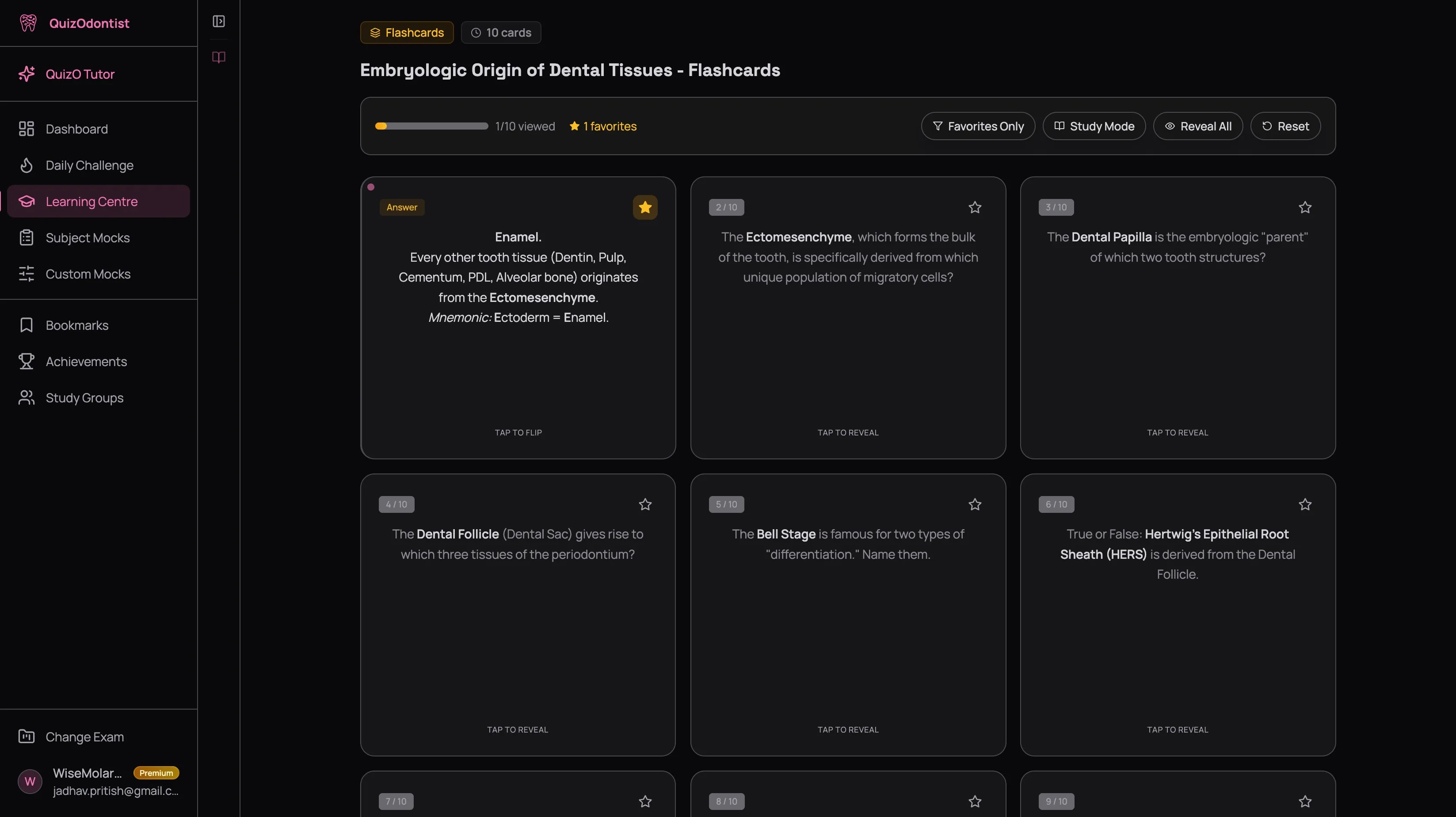
Each card shows a prompt on the front. Tap to reveal the answer on the back. Simple UI, on purpose — the magic isn't in the interface, it's in what happens in your head between reading the prompt and seeing the answer.
The default view shows all cards in a grid. When you want to lock in, hit Study Mode — it switches to a focused single-card view that blocks out everything else.
Read the prompt
"The Ectomesenchyme, which forms the bulk of the tooth, is specifically derived from which unique population of migratory cells?" Don't touch the card yet.
Answer in your head first
This is the step everyone skips and it's the only one that matters. Pause. Formulate your answer. Say it to yourself. If you can't — good. That's the retrieval attempt doing its job.
Reveal and compare
Tap to flip. Were you right? Partially right? Completely wrong? That moment of comparison — the "oh, it was Neural Crest cells, not mesoderm" — is where the memory solidifies.
Star what tripped you up
Got it wrong or felt shaky? Tap the star. Starred cards get saved to your Bookmarks for targeted review later. That star is you telling your future self: this one needs more reps.
Why the Struggle Matters
If every flashcard feels easy, you're either already fluent in the material or you're flipping too fast without actually testing yourself.
Here's the counterintuitive truth: the cards you get wrong are more valuable than the ones you get right. That frustrating moment where the answer is on the tip of your tongue — "it's the dental... follicle? No, papilla" — is doing more for your long-term retention than any amount of re-reading ever could. Researchers call it desirable difficulty. The effort of failing to retrieve, then seeing the correct answer, creates a deeper memory trace than passively scanning the same paragraph ten times.
Nobody aces flashcards on their first pass through a new subject. The people who pass these exams are the ones who kept showing up for the cards that made them uncomfortable — day after day, until the discomfort turned into recall.
Getting every card right in Oral Surgery? Great — you don't need more reps there. Switch to the Pharmacology lesson where you're getting half of them wrong. Your study time is limited. Spend it where the cards make you sweat, not where they make you feel smart.
Starred Flashcards and Bookmarks
When you star a flashcard, it lands in your Bookmarks — accessible from the sidebar, pulling starred cards from every subject into one place.
Over weeks of studying, your Bookmarks become a curated collection of your exact weak points across Pharmacology, Anatomy, Pathology, Biochemistry — everything. Before the exam, instead of reviewing 500 lessons, you review 80 starred cards. That's not cutting corners. That's precision.
AFK and INBDE both test across 15+ subjects. Reviewing starred cards from different subjects in one session trains exactly the kind of cross-domain recall the exam demands — jumping from a microbiology question to a pharmacology question to an anatomy question without warning.
Pop Quizzes
After flashcards, the final activity is the pop quiz — 3 to 6 multiple-choice questions in the exact format you'll face on exam day.
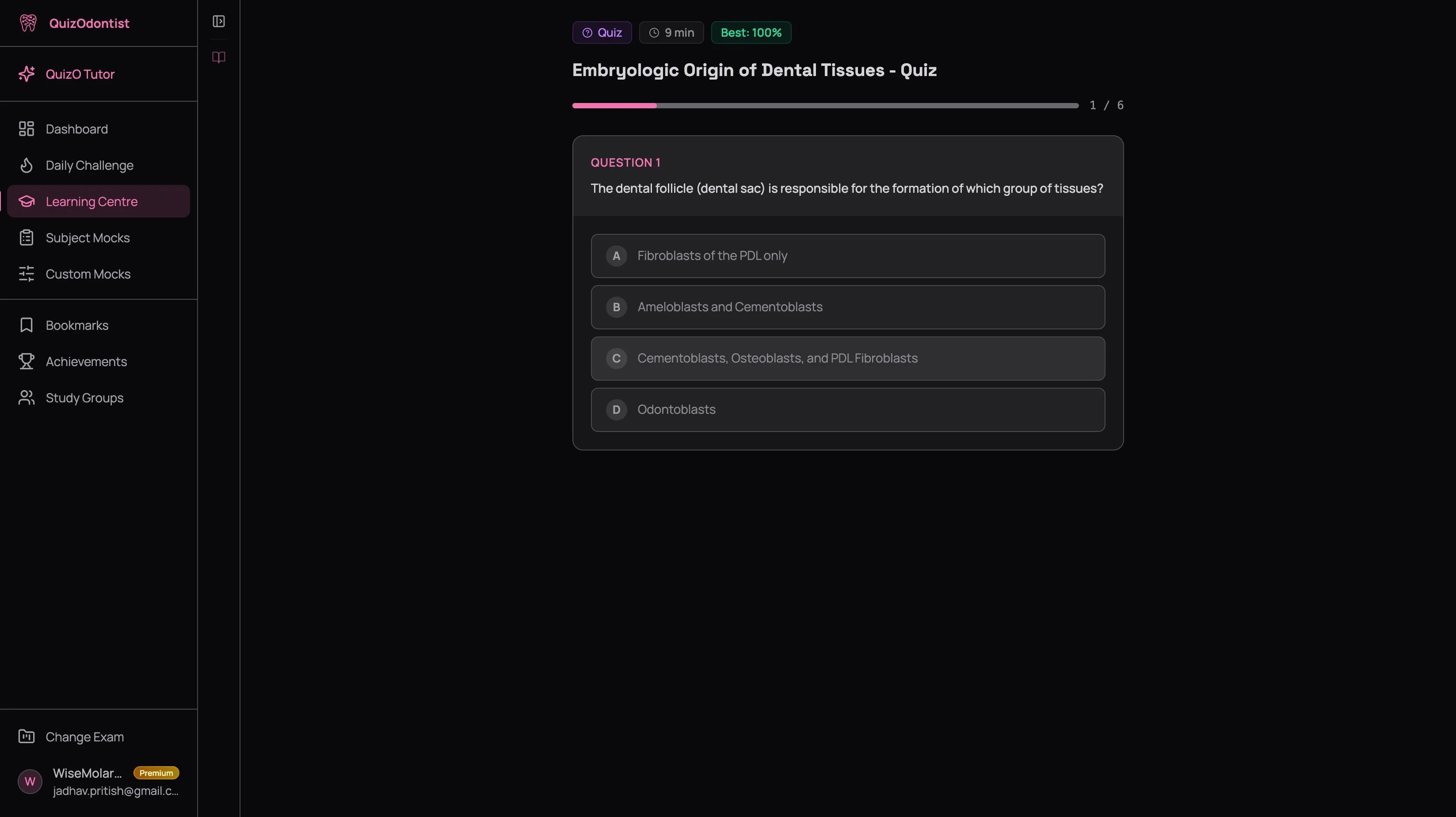
The questions are mapped to the lesson's content. If you just read about embryologic origins, the quiz tests embryologic origins — not random topics from the same subject. This tight mapping means when you get a question wrong, you know exactly which section to re-read.
Every Option Gets an Explanation
This is where pop quizzes earn their keep. After you submit, you don't just see a score. You get a full explanation for every option — including why each wrong answer is wrong and what misconception it's testing.
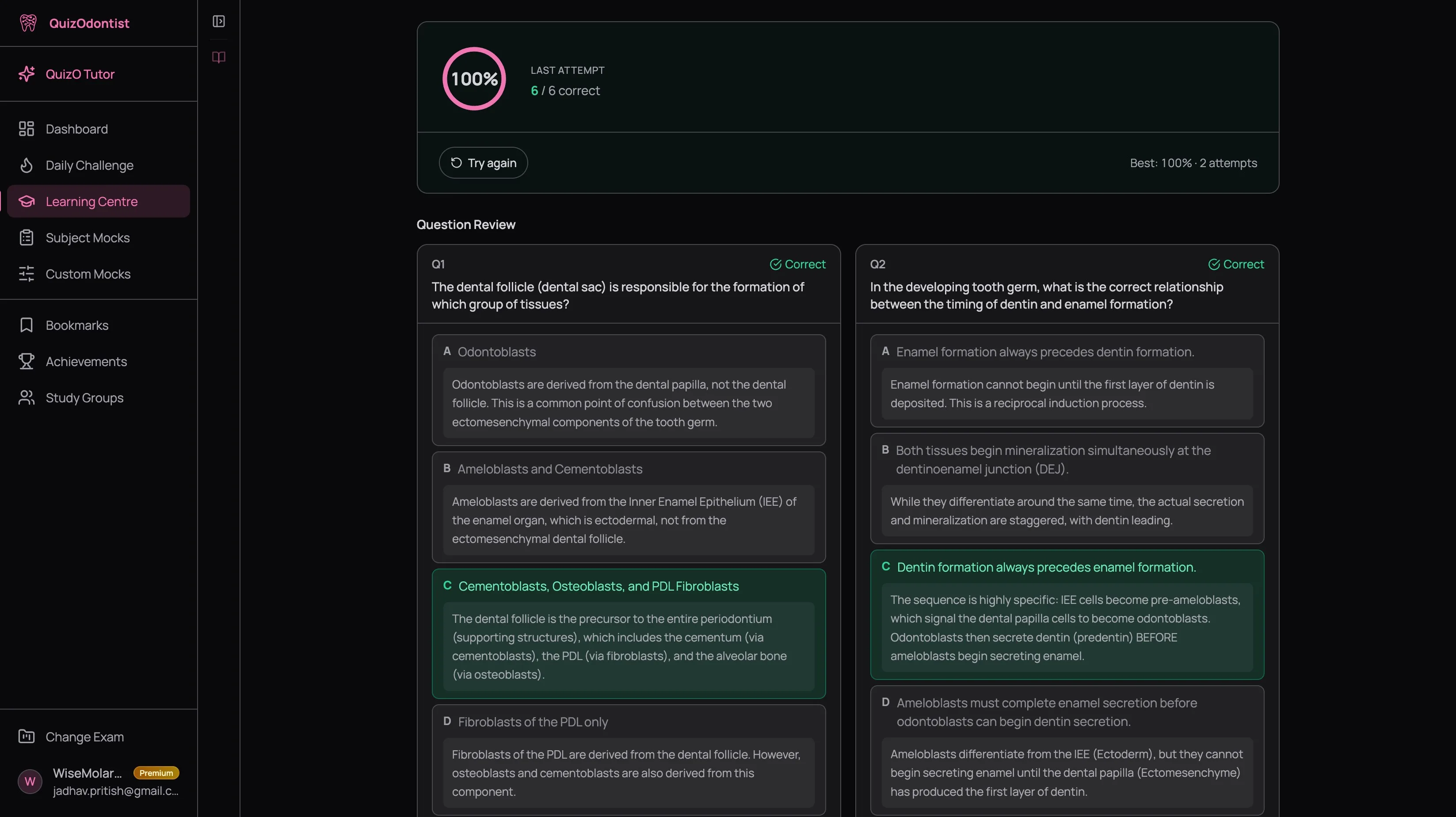
Read all four explanations on every question. Even the ones you got right. Especially the ones you got right by guessing — because a lucky guess on a pop quiz becomes a wrong answer on the real exam.
The explanations often contain nuance the reading didn't emphasize. A distractor might reveal a common misconception you didn't know you had. That's free learning — the kind you only get by testing yourself first.
"Why is B wrong?" is often more instructive than "Why is C right?" The distractors are designed around real exam traps — the confusions between dental papilla and dental follicle, the timing of dentin vs. enamel formation, the origin of HERS. Understanding why wrong answers look right is half the battle.
Pop Quiz Scores Are Private
Here's something important: pop quiz scores do not appear on your Dashboard. They don't affect your stats, your score trend, or your analytics. On purpose.
Pop quizzes are learning tools, not assessments. They're designed for you to struggle, get things wrong, and learn from the explanations. If scores showed up on the Dashboard, you'd start gaming the quiz instead of learning from it — skipping questions you weren't sure about, re-reading before attempting, optimizing for the number instead of the understanding.
Score 2 out of 6 on a pop quiz? That's not failure — that's the quiz doing its job. It just identified four concepts you need to revisit. Go back to the reading, re-read those sections, and move on. Your Dashboard scores will climb when you take real Practice Quizzes later.
Practice Quizzes and Custom Mocks are where you measure yourself. Pop quizzes are where you learn. Different tools, different purpose.
Building a Review Habit
One pass through a lesson isn't enough. You'll lose the majority of what you learned within 48 hours if you don't revisit it — that's just how memory works.
The tools are already in place. Use them:
- Starred flashcards accumulate in Bookmarks — review them every few days
- Pop quizzes can be retaken — the second attempt, informed by the explanations you read, is where real consolidation happens
- Lesson notes and annotations are waiting when you return — your future self already highlighted the parts that matter
- The Daily Challenge keeps you in the habit even on days you don't feel like a full study session
You don't need a complex spaced repetition algorithm. You need the discipline to come back. The Bookmarks section, the re-takeable quizzes, and your notes from the reading give you everything you need.
Twelve hours the night before feels heroic. It isn't. A little every day for months beats an all-nighter every time — and the data backs it up.
Next Up
Flashcards and pop quizzes are training wheels — low-stakes retrieval practice tied to individual lessons. But at some point you need to test yourself under real conditions: timed, multi-topic, exam-format questions where the score counts.
Head to Practice Quizzes to learn how to browse subject mocks, filter by topic, and track your performance on the Dashboard. Or jump to the Custom Mock Builder to build targeted exams that hit your exact weak spots.